Click the Play Button Below for an Audio Summary [audio:https://www.johndavisconsulting.com/wp-content/uploads/2010/08/Late-Breaking-Trends-Aug-31.mp3|titles=Late Breaking Trends Aug 31] Key Trends and their Impact on North Carolina’s 2010 General Election Races Advantage Democrats Advantage Republicans “Republican average weekly advantages over Democrats during August are higher than any previous midterm Republican advantage in Gallup’s history of tracking the generic ballot, which
[More…]
Podcast: Play in new window | Download
| Click the Play Button Below for an Audio Summary |
| [audio:https://www.johndavisconsulting.com/wp-content/uploads/2010/08/Late-Breaking-Trends-Aug-31.mp3|titles=Late Breaking Trends Aug 31] |
 |
 |
|
Key Trends and their Impact on North Carolina’s 2010 General Election Races
|
|
 Advantage Democrats
“Republican average weekly advantages over Democrats during August are higher than any previous midterm Republican advantage in Gallup’s history of tracking the generic ballot, which dates to 1942.” Gallup News Release, August 30, 2010
Post: August 31, 2010, by John Davis
GOP HEAT WAVE BREAKS 68-YEAR-OLD RECORD DATING TO 1942
It has been hot here in Raleigh this year. As a matter of fact, this summer we had a 102° day that broke a 61-year-old record for heat in the Triangle. Politically, throughout the United States, it has been a long, hot summer too … especially for Republicans. According to Gallup, when it comes to political heat, the Grand Ole Party has broken a 68-year-old record.
Yesterday, Monday, August 30, 2010, Gallup announced that Republicans had a 51% to 41% lead over Democrats among registered voters in Gallup’s weekly tracking of 2010 congressional generic ballot. Gallup stated that Republican weekly leads over Democrats in August “are higher than any previous midterm Republican advantage in Gallup’s history of tracking the generic ballot, which dates to 1942. That’s 68 years ago … a fact that cannot be overemphasized.
August has not ended well for Democrats. Just last week, on the economic/political fronts:
- Sales of existing homes dropped 27% from June to July, the lowest point since 1999.
- The Dow closed just below 10,000 for the first time since early July.
- On Friday, Fed Chairman Ben Bernanke described the nation’s economic outlook as “inherently uncertain” and said the economy “remains vulnerable to unexpected developments.”
- ON THE POLITICAL FRONT: In Florida last Tuesday, the Democratic Senate primary drew just over 900,000 voters; the Republican primary, more than 1,250,000. National political observers said that independents went Republican on Tuesday in huge numbers; and that Republicans turned out big … a lot of Democrats stayed home.
- ALASKA UPSET: Perhaps the biggest news of the day last Tuesday was the apparent upset of Alaska GOP Sen. Lisa Murkowski, who outspent her Sarah Palin and Tea Party backed opponent 20-to-1 … the outcome to be decided this week by absentee ballots.
- Also on Tuesday, the North Carolina State Board of Elections fined Democratic Gov. Perdue $30,000 for failing to disclose 42 private airplane flights in a timely manner.
- Wake County DA Colon Willoughby is reviewing the records to see if any further action is warranted. Listen for the roar of airplane engines in those political ads this fall.
- DISSENTION IN THE DEMOCRATIC RANKS: The State Employees Association of North Carolina (SEANC) picketed the home of Ken Eudy, former head of the state Democratic Party, during a fundraiser last week for the state Senate Democratic Caucus. According to Tom Campbell with NCSPIN, there were more uninvited protestors than invited guests.
- Campbell also reported that another NC Senate Caucus fundraiser in Linville was attended by mostly Appalachian State University folks … and that both Senators Marc Basnight and David Hoyle were reportedly pessimistic about the fall elections.
As if last week’s news wasn’t bad enough, now, Gallup makes two major political announcements on Monday: the GOP’s record-breaking lead over Democrats on the generic congressional ballot question, and, Gallup announced on Monday that Republicans have a 25-point lead over Democrats when it comes to voters who are “very enthusiastic” about voting this fall … the largest advantage of the year.
Republicans are poised to take the US House this fall; not as likely to take the US Senate … the opportunities just are not there. However, here in North Carolina, Republicans have their best shot since 1994 of winning a majority of the seats in both houses of the General Assembly.
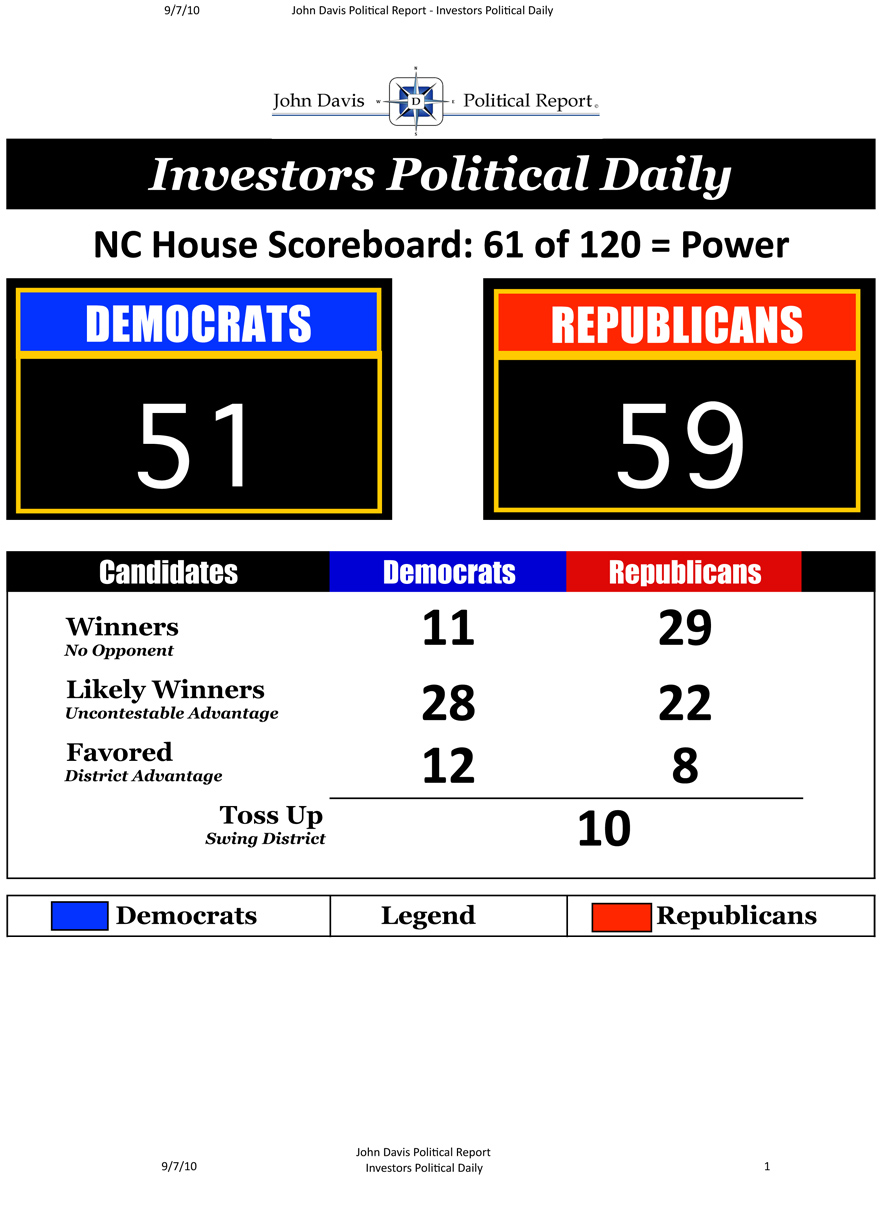
Coming soon to the John Davis Political Report: Investors Political Daily. This new feature will highlight free-market candidates who will win IF you will invest in their candidacy. I will also keep a running count of where both parties are in the battle for the legislative majority.
WEBSITE REMODELING NEAR COMPLETION – LOOK FOR LABOR DAY LAUNCH
When you finish this report, take a look at today’s Late Breaking Trends Senate and House charts and you will see two changes:
- First, I have consolidated the two campaign finance variables … mid-year “Cash on Hand” of all candidates by party along with “Party Fundraising.” I did this because historically candidates who do not need all of their money pass it on to the party who uses it to help other party candidates. Ultimately, it’s all the same war chest.
- However, knowing the importance of the financial advantage in a campaign, I quadrupled the weight of the combined fundraising in the algorithm. No other variable weighs more.
- Finally, I have added the NC Obama “Job Approval” variable. After pouring over polls all last week, it became very clear that this election is a referendum on President Obama. This variable is tripled in the “Late Breaking Trends” algorithm.
Well, there you have it. The week began with North Carolina Republicans continuing their partisan political advantage … by 16 points in the Senate chart, and by 12 points in the House chart. All else being equal, the Republican momentum going into the General Election races adds 8 points to GOP state Senate candidates and 6 points to GOP state house candidates. Remember, momentum translates into enthusiasm which translates into money and volunteers and fired-up candidates. It’s the winning difference in close races.
Thanks again for reading and listening to the John Davis political report.
Click the Play Button Below for an Audio Summary [audio:https://www.johndavisconsulting.com/wp-content/uploads/2010/08/Late-Breaking-Trends-Aug-27-Take-2.mp3|titles=Late Breaking Trends Aug 27 Audio] Key Trends and their Impact on North Carolina’s 2010 General Election Races Advantage Democrats Advantage Republicans “I understand that intellectually,” said Obama, “but this is my life and career. And I think I could probably do every job on the
[More…]
Podcast: Play in new window | Download
| Click the Play Button Below for an Audio Summary |
| [audio:https://www.johndavisconsulting.com/wp-content/uploads/2010/08/Late-Breaking-Trends-Aug-27-Take-2.mp3|titles=Late Breaking Trends Aug 27 Audio] |
|
|
|
Key Trends and their Impact on North Carolina’s 2010 General Election Races
|
|
“I understand that intellectually,” said Obama, “but this is my life and career. And I think I could probably do every job on the campaign better than the people I’ll hire to do it.”[1] David Plouffe, Obama’s campaign manager, The Audacity to Win, 2009
Post: August 27, 2010, by John Davis
HOW WILL OBAMA’S FALL FROM FAVOR IMPACT NC’s RACES IN 2010
Have you ever been turned off by one of those cocky conservatives … one of those sanctimonious know-it-alls who behave as if their notions of what’s best for our state and nation should be enacted with righteous indifference to the will of the governed? I thought you might have. So now you know why the country is mad at President Barack Obama … and why North Carolina Democrats are likely to pay dearly this fall.
President Obama’s job approval is at record lows because he comes across like a sanctimonious know-it-all who thinks his left-of-center notions of what’s best for our nation should be enacted with righteous indifference to the will of the governed … most of whom are either conservative or moderate.
According to a study of national ideological identity released by Gallup earlier this month, “Americans are much more likely to identify themselves politically as conservative than as liberal in 49 of 50 states.[ii] On average, conservatives outnumber liberals by about 20 percentage points across all states. Only in the District of Columbia and Rhode Island did liberals outnumber conservatives during the first half of 2010.
The Gallup study shows that 42% of respondents this year said that they are either “conservative” or “very conservative.” Only 20% have told Gallup they are “liberal,” with 35% of Americans say they are “moderate.” It’s no wonder that President Obama, the highest ranked liberal member of the U.S. Senate before winning a set of keys to the Oval Office, is struggling with high negative job approval numbers.
In his book, The Audacity to Win, President Obama’s campaign manager David Plouffe writes about Obama’s “substantial ego,” recalling their first meeting in Chicago back in 2004. He was trying to persuade Obama of the importance of allowing campaign professionals to run his U.S. Senate campaign. “You just have to let go and trust,” Plouffe told him. “I understand that intellectually,” said Obama, “but this is my life and career. And I think I could probably do every job on the campaign better than the people I’ll hire to do it.”[iii]
Sound familiar? That’s why he is in trouble with the American public, and hurting the chances of Democrats in North Carolina this fall. He acts as if he and the other 20% of the “liberal” voters in America know better how to solve the problems of the day than the 80% who are either conservative or moderate.
What about North Carolina … our ideological identity? Well, according to Gallup, “Liberals” total only 16% as of mid-year 2010; “Conservatives” total 43%; “moderates” total 37%. Looking only at the all-important Unaffiliated voters, now numbering 1.44 million in our state … nearly one in four of all voters … only 15% are “Liberals,” with 41% saying they are “Conservatives” and with “moderates” totaling another 41%. These are the folks who carried the state for Obama and Perdue and Hagan in 2008 … they kept the Democrats in the drivers seat.
Chris Hayes, Senior Legislative Analyst with the John W. Pope Civitas Institute in Raleigh is doing a politically invaluable four-part study of North Carolina’s “Unaffiliated” voters in a series titled, “Analyzing the State Legislative District Polling.”[iv] In Part 3 of the series, subtitled “The Obama Effect,” Hayes makes the following startling comparison of Obama’s favorability ratings among “Unaffiliated” voters in North Carolina today as compared to 2008:
“In an October 2008 Civitas poll, weeks before the presidential election, Obama’s favorability rating with Unaffiliated voters was +15 (54% favorable, 39% unfavorable). But in just under two years time, the tables have turned. In a Civitas August 2010 poll of Unaffiliated voters, Obama’s favorability rating had fallen to -7 (42% favorable, 49% unfavorable). Obama has suffered a net loss of 22 percentage points in his favorability rating and his prospects for recovery do not seem to be improving,” concludes Hayes.
Imagine running Down East this fall as a Democrat. Does anyone really believe that those conservative Eastern North Carolina yellow-dog Democrats … formerly AKA Jessecrats … are just going to roll over like trained puppies and support the party’s candidates after being insulted time and again by the indifference of this White House to their notions of what’s right? Many of those Down East legislative districts that have always elected Democrats are now in play.
President Obama still has a chance to minimize the negative impact his fall from favor is having on the political fortunes of North Carolina Democrats. First, he must accept the fact that you can’t do as you please in a nation founded on the principle of respect for the “consent of the governed.” Second, he must accept the fact that conservatives outnumber liberals by statistically significant margins in 49 of the 50 states … and that nationally and here in the old North State, 80% of us are not liberal.
Well, there you have it, now you know why the country is mad at President Barack Obama … and why North Carolina Democrats are likely to pay dearly this fall.
Thank you for reading … and listening to … the John Davis Political Report.
[i] The Audacity to Win, by David Plouffe, Campaign Manager for Obama for America, Viking Press, Pg. 8.
[ii] http://www.gallup.com/poll/141677/Wyoming-Mississippi-Utah-Rank-Conservative-States.aspx#2
[iii] The Audacity to Win, by David Plouffe, Campaign Manager for Obama for America, Viking Press, Pg. 8.
[iv] Analyzing the State Legislative District Polling, The Obama Effect, by Chris Hayes, Senior Legislative Analyst, Civitas.
Click the Play Button Below for an Audio Summary [audio:https://www.johndavisconsulting.com/wp-content/uploads/2010/08/Late-Breaking-Trends-Aug-24.mp3|titles=Late Breaking Trends Aug 24] Key Trends and their Impact on North Carolina’s 2010 General Election Races Advantage Democrats Advantage Republicans “North Carolina Republicans have an asset this year Democrats don’t have: Tom Fetzer.[i] Democratic consultant Gary Pearce, Talking About Politics, The Fetzer Factor, April 7,
[More…]
Podcast: Play in new window | Download
| Click the Play Button Below for an Audio Summary |
| [audio:https://www.johndavisconsulting.com/wp-content/uploads/2010/08/Late-Breaking-Trends-Aug-24.mp3|titles=Late Breaking Trends Aug 24] |
|
|
|
Key Trends and their Impact on North Carolina’s 2010 General Election Races
|
|
“North Carolina Republicans have an asset this year Democrats don’t have: Tom Fetzer.[i] Democratic consultant Gary Pearce, Talking About Politics, The Fetzer Factor, April 7, 2010
Post: August 24, 2010, by John Davis
DEMOCRATIC LEADERS IN CRISIS – A STORM SURGE THREATENS
North Carolina Democrats have been successful for decades because of leadership, unity, and the willingness to work hard to raise the money needed to keep the majority in the state Senate and House … as well as the majority on the Council of State. This year, an anti-establishment storm surge is threatening their shores. However, a stormy election year is not new. They have survived many of those. What is new is that at a time that they need strong leadership the most, many of their leaders are embroiled in one crisis after another.
EMBATTLED STATE BOARD OF ELECTIONS FINES PERDUE $30,000 TODAY: Today, the Democratic-led North Carolina State Board of Elections met in Asheville to consider evidence that Democratic Gov. Perdue cheated on her campaign finance reports by failing to disclose 42 private airplane flights in a timely manner. Ruling: She was fined $30,000 for failure to report the 42 campaign flights on private aircraft. Former Democratic Gov. Mike Easley has already been fined $100,000 for breaking the rules with regards to reporting private flights. Ironically, the Democratic Chairman of the State Board of Elections is being accused of interjecting himself improperly into a staff investigation of Gov. Perdue’s campaign reporting, and the Democratic Executive Director of the State Board of Elections is under scrutiny for allowing his partisan bias to influence his decisions in the Perdue case. All in all, a political nightmare.
SEANC PROTESTING AT NC SENATE FUNDRAISER TONIGHT: Tonight, the State Employees Association of North Carolina (SEANC) will be picketing outside the home of Ken Eudy, former head of the state Democratic Party, who is hosting a fundraiser for the state Senate Democratic Caucus. SEANC has accused Eudy, CEO of a PR firm named Capstrat, of “pay-to-play” politics, for having received millions of dollars in state contracts.
NC DEMOCRATIC PARTY CHAIRMAN DAVID YOUNG UNDER FIRE: Meanwhile, according to Tom Campbell in last week’s NC SPIN online report, current state Democratic Party Chairman David Young, “… has been relegated to the back seat because of the internal grumbling about his low-profile performance and the lack of any type of aggressive communication effort.”[i] Campbell writes that a coordinate campaign for the fall is being headed up by others to pick up the slack. Not good folks.
Young also faced criticism back home in Asheville in May because of a complaint about orange-colored water in a mobile home park he owns in Weaverville. The Asheville Citizen-Times columnist John Boyle scolded Young in a May 27 commentary titled, Time for David Young to do the right thing, saying, “You’ve been a politician for two decades, and you head the party that stakes a claim to helping the least affluent among us. And this is how you treat the people who live in your trailer park?” Ouch!
NC GOP CHAIRMAN TOM FETZER A “HEAT-SEEKING MISSILE”
While Young struggles to get his footing during his first election year as the head of the NC Democratic Party, Tom Fetzer, new head of the NC Republican Party, is getting high marks for successes in uniting the party, raising money, and driving the Democrats nuts. Fetzer’s modus operandi is best described as an unrelenting, in-your-face, attack-dog style of partisan combat.
Even long-time Democratic consultant Gary Pearce has been complimentary of Fetzer’s performance as GOP chairman. In April, Pearce wrote in his blog titled Talking About Politics, “North Carolina Republicans have an asset this year Democrats don’t have: Tom Fetzer.[ii] Pearce noted that Fetzer was going around the state like a “heat-seeking missile,” while his Democratic counterpart is “clearly not comfortable playing the role of political hit man.”
THE STORM SURGE IS IN THE DETAILS
When you finish this report, take a look at today’s Late Breaking Trends Senate and House charts and you can clearly see the storm surge that threatens Democrats this fall.
- Aug. 23: Gallup says Obama’s weekly “job approval” average at a new low of 43%, and that this is his first weekly average “job disapproval” above 50%.
- “If Perdue’s numbers continue to be this poor, she will likely be a drag on Democratic legislative candidates this fall,” said Tom Jensen with Democratic-leaning Public Policy Polling in April. According to today’s POLLSTER.COM, Perdue’s rolling average “unfavorable” is 40%; “favorable 33.3%.[iii]
- Economic conditions are perceived as “Excellent/Good” by only 12% of Americans.
- Shakeup in the NC Senate Caucus has resulted in the departure of Sen. Basnight’s closest allies and savviest political generals. Add the eight retirements in the Senate Democratic Caucus and you can readily see an unprecedented degree of difficulty in 2010.
- Senate Republicans are at virtual parity in mid-year Cash-on-Hand, reporting $2.4 million Cash-on-Hand to $2.5 for all Democratic candidates.
- House Republicans have the strongest and most disciplined tag-team in memory, with Minority Leader Skip Stam sharing the war duties with Minority Whip Thom Tillis.
- Republicans have stolen Obama’s playbook and say they will not be beat in early voting turnout.
- Democratic fundraising prowess is weakened by three things: the economy, the intense investigations into campaign finance violations, and … everyone is hedging their bets.
- Loyalty dies as power wanes. Remember, in politics, there are no permanent enemies and no permanent friends.
But most of all, what is truly different about North Carolina politics as we near the Labor Day kickoff of the fall campaigns, is that at a time the Democrats need strong leadership the most, many of their top leaders are embroiled in one crisis after another. You can handle a political storm surge provided you have strong leaders. Without leaders, you’re in a whole lot of trouble.
Thank you for reading … and listening to … the John Davis Political Report.
[i] http://www.ncspin.com August 19, 2010 post
[ii] Talking About Politics, The Fetzer Factor, Posted April 7, 2010
[iii] http://www.pollster.com/polls/nc/fav-perdue.php
Click the Play Button Below for an Audio Summary [audio:https://www.johndavisconsulting.com/wp-content/uploads/2010/08/John-Davis-LBT-8-20-Revised-8-21.mp3|titles=John Davis LBT 8 20 Revised 8 21] Key Trends and their Impact on North Carolina’s 2010 General Election Races Advantage Democrats Advantage Republicans “Democratic operatives trying to raise money for expensive ad campaigns report that the wealthy liberals (and, to some extent, labor unions) who
[More…]
Podcast: Play in new window | Download
| Click the Play Button Below for an Audio Summary |
| [audio:https://www.johndavisconsulting.com/wp-content/uploads/2010/08/John-Davis-LBT-8-20-Revised-8-21.mp3|titles=John Davis LBT 8 20 Revised 8 21] |
|
|
|
Key Trends and their Impact on North Carolina’s 2010 General Election Races
|
|
“Democratic operatives trying to raise money for expensive ad campaigns report that the wealthy liberals (and, to some extent, labor unions) who wrote huge checks to independent groups for advertising campaigns in the past three election cycles, are sitting on their wallets.” Politico, “GOP outside cash has Dems scrambling,” 8/20/2010
Post: August 20, 2010, by John Davis
WEEK IN REVIEW: This week ended as it began, with Republicans enjoying favorable political winds in their sails. On Tuesday, I pointed out that “underemployment” … which includes Americans who are unemployed and those who are working part-time but wanting full-time work … is over 18%. Among Americans without college degrees, 23% are underemployed. Among young people in the 18-to-29-year-old age range, underemployment is at 28%. But the most startling number is this: almost 4 in 10 of the youngest of the young voters … those 18-to-24 years old … are underemployed. Those voters, who were filled with enthusiasm in 2008 because of the inspiring campaign of President Obama, are now disenchanted.
Compounding the negative political fallout for Democrats of high “underemployment” is a lack of job security among those who are employed. According to a new study released by Gallup this week, almost 40% of those who are employed are worried that their benefits will be reduced; one in four are worried that they will be laid off or have to accept a cut in pay.
“UNDEREMPLOYMENT” TAKEAWAY: “Underemployed” voters, along with those who lack job security, are going to do one of two things on Election Day this November: not vote or vote against the establishment … Democrats.
OBAMA’S JOB APPROVAL PLUMMETING: Other new numbers this week that bode ill for Democrats include President Obama’s job approval. According to Real Clear Politics, a website that keeps a rolling average of all national polls during the previous two weeks, Obama’s job approval reached a weekly average low of only 44%. Today, Friday, August 20, Gallup has Obama’s job approval at a three-day rolling average of only 41%, with 52% of Americans disapproving.
It’s no wonder that we are also seeing enthusiasm trending more favorably for Republicans than Democrats. This week, 44% of Republicans told Gallup that they were very enthusiastic about voting this fall. Among Democrats, only 28% said they were very enthusiastic.
WEALTHY LIBERALS SITTING ON WALLETS: According to a story in today’s Politico, “GOP outside cash has Dems scrambling,” the Democratic Party’s lack of enthusiasm is a donor phenomenon as well.[i] “Democratic operatives trying to raise money for expensive ad campaigns report that the wealthy liberals (and, to some extent, labor unions) who wrote huge checks to independent groups for advertising campaigns in the past three election cycles, are sitting on their wallets.” The article attributes the decline in liberal money to the “lingering recession,” the “absence of a single unifying enemy” like President George W. Bush, disenchantment with the Obama political operation, and tension between the White House and organized labor.
Politico writer Kenneth Vogel notes that 7-out-of-10 of the largest and most successful independent Democratic-leaning groups from the past three election cycles are behind in their fundraising … “some by a wide margin.”
NC DEMOCRATS AND LABOR FEUDING OVER PAY-TO-PLAY POLITICS: The growing tension between organized labor and the White House became very apparent in Arkansas in June, when unions spent $3.1 million trying to defeat White House-backed US Sen. Blanche Lincoln … because she didn’t support their agenda on health care. After being criticized by the White House for their failed effort to defeat Lincoln, AFL-CIO spokesman Eddie Vale said, “Labor isn’t an arm of the Democratic Party.”[ii] Those are feuding words.
We have seen similar tension grow this year between organized labor in North Carolina and the state Democratic Party. SEANC, the state employees association … an affiliate of the Service Employees International Union, worked with SEIU to create a new political party called North Carolina First. Why? To teach the state’s three conservative Democratic US Congressmen a lesson … because they voted against the union position on Obama’s healthcare bill.
Historically, it is Republicans who have diluted their political effectiveness with internal feuding. This year it’s the Democrats. This week we saw evidence of that split in the Democratic Party when Dana Cope, head of SEANC, attacked former state party chairman Ken Eudy for “pay to play” politics … because Eudy, who has received numerous lucrative state contracts, is planning a fundraiser at his home featuring NC Senate Democratic Caucus leaders.
NC SENATE MARTIN NESBITT SAID: About the accusation of “pay-to-play” impropriety, Senate Majority Leader Martin Nesbitt from Buncombe County said, “You can’t deny someone the right to participate in politics simply because they do business with the state.” I agree with Sen. Nesbitt. But I also think he should have added the following sentence: “You can deny someone business with the state if they don’t participate in Democratic Party fundraisers.”
DEMOCRATS HAVE TOUGHER HILL TO CLIMB: Democrats are masters at using the leverage of power to gain the financial advantage necessary to win close races in years when the political winds favor Republicans. But this year their challenges are far greater. They have lost their old warrior general in former Senator Tony Rand, and six members of their caucus retired leaving novice candidates in Republican-friendly territories … like the seats being vacated by Sen. Hoyle from Gaston County, Sen. Bozeman from New Hanover County, and Sen. RC Soles from Columbus County.
Several others in the Senate Democratic Caucus are seriously threatened … including four in seats once held by Republicans like Sen. John Snow from Cherokee County, Sen. Joe Sam Queen from Haywood County, Sen. Steve Goss from Watauga County and Sen. Tony Foriest from Alamance County.
All in all, if the political trends continue the Republican friendly track of this week, we just may see Republicans make history in November with the takeover of the state senate and house.
Thanks for reading … and listening to … the John Davis Political Report.
[i] http://dyn.politico.com/printstory.cfm?uuid=8C2FC588-18FE-70B2-A8D1B9A2F56EB579
[ii] http://www.politico.com/blogs/bensmith/0610/AFL_to_White_House_Labor_isnt_an_arm_of_the_Democratic_Party.html
Click the Play Button Below for an Audio Summary [audio:https://www.johndavisconsulting.com/wp-content/uploads/2010/08/JDavis-LateBreakingTrends081810.mp3|titles=Late Breaking Trends – August 18, 2010] Key Trends and their Impact on North Carolina’s 2010 General Election Races Advantage Democrats Advantage Republicans President Obama’s job approval reached a new weekly average low, with only 44% of American voters approving of how the president is managing
[More…]
| Click the Play Button Below for an Audio Summary |
| [audio:https://www.johndavisconsulting.com/wp-content/uploads/2010/08/JDavis-LateBreakingTrends081810.mp3|titles=Late Breaking Trends – August 18, 2010] |
|
|
|
Key Trends and their Impact on North Carolina’s 2010 General Election Races
|
|
President Obama’s job approval reached a new weekly average low, with only 44% of American voters approving of how the president is managing the country. Gallup, 8/17/2010
Post: August 18, 2010, by John Davis
NEW TRACKING CHARTS: If you take a look at the bottom of today’s Senate and House Late Breaking Trends charts, you will see that I have added a graph at the bottom of the page. This graph will be used to plot the partisan political advantage trend line all the way from this week to Election Day. After two election cycles with the momentum favoring Democrats, the numbers now show a solid momentum advantage for Republicans leading up to the all-important Labor Day kick-off of the General Election season.
Republican state Senate candidates, with an 8-point momentum advantage, fair slightly better than their state House counterparts because the Senate GOP Caucus has been more successful in raising early money. Mid-year reports filed with the State Board of Elections show a virtual dead-heat in the total Cash-on-Hand of all Senate Republican and Democratic candidates. Democrats reported $2.5 million Cash-on-Hand; Republicans reported $2.4 million. On the House side, Democrats reported $3.3 million Cash-on-Hand; Republicans reported $1.3 million. The North Carolina FreeEnterprise Foundation has done an excellent summary of the mid-year finance reporting by legislative candidates.[i] You can review it on their website: www.ncfef.org.
For many election cycles, the three-to-one … four-to-one … five-to-one disparities in campaign funding has helped Democrats win the close races … races that ultimately decided the majority in the state Senate and House. Here are a couple of good examples from 2008:
- Sen. Julia Bozeman, a New Hanover County Democrat, spent $871,539 to win 52% of the vote against her GOP challenger who spent only $250,075 … in a Democratic-friendly year that saw record-breaking new registrations and turnout for Democrats. The Democratic Party gave Bozeman $555,475. The Republican Party contributed only $77,500 to their candidate. This year is a Republican friendly year. The seat, once held by GOP Sen. Patrick Ballantine, is open … meaning all advantages of incumbency are lost … and the money is even. Civitas gives this district a GOP-friendly R+3 on it’s NC Partisan Index.[ii]
- Sen. Toni Foriest, an Alamance County Democrat, spent $647,293 to win 52% of the vote against his GOP challenger who spent only $173,152 … in a Democratic friendly year that saw record-breaking new registrations and turnout for Democrats. This is a Republican friendly year, the money is even, and the seat was held by GOP Sen. Hugh Webster for six terms. Civitas gives this district and R+3 on it’s NC Partisan Index
So, as you can see, this election year things are quite different. No one has ever seen Senate Republicans even with Democrats in any fundraising category. And, it has been more than a decade since House Republicans were as well organized and poised to exploit their momentum advantage and close the funding gap. Add the fact that Republicans are working together to defeat Democrats rather than each other, and you can readily see that something is quite different this year in the politics of the Ole North State. Perhaps, just perhaps, we are seeing the makings of a powerful Republican political war machine that will rival the national model war machine build by North Carolina Democrats.
Yesterday, the GOP momentum advantage increased with the release of new polling information from the Gallup organization. Here are the highlights:
- Generic Congressional Ballot Favors GOP: “GOP shows strongest positioning yet in 2010 votes cast,” reads the headline of Gallup’s latest release of congressional generic ballot results. The national survey of registered voters asked: If the election for congress were held today, would you vote for the Democrat or the Republican? Republicans, who were favored by only 43% in mid July, now enjoy a 50% to 43% advantage among US registered voters.
- Obama’s Job Approval at Historic Low: President Obama’s job approval reached a new weekly average low, with only 44% of American voters approving of how the president is managing the country
- Party ID Tied: Another trend that does not bode well for Democrats is the loss of advantage with the number of Americans who identify themselves as Democrats rather than Republicans. In January, Democrats had a 45% to 40% advantage. Today, both parties are tied with 42% each.
- Independent Voters Trending Republican: One of the most startling findings by Gallup thus far in August is that Independent voters in the country are far more inclined to vote for Republicans for Congress this year than for Democrats. Republicans received a 47% thumbs up; Democrats only 34%. Thirteen points is a major disparity.
- Voter Enthusiasm Trending Republican: But perhaps the most startling finding by Gallup deals with the enthusiasm among the Republicans and Democrats about voting this fall. Among Republicans, 44% say they are “very enthusiastic” about voting this fall. Among Democrats, a dismal 28% say they are “very enthusiastic.”
So, there you have it, a Republican-friendly fall in the making based in the Late Breaking Trends … found only in the John Davis Political Report. Remember, take a look at the bottom of today’s Senate and House Late Breaking Trends charts so that you can see the new graph for tracking how the partisan political advantage changes between now and Election Day.
Thanks for reading … and listening … to the John Davis Political Report.
[i] http://ncfef.org/NCFEF_News/Entries/2010/8/12_Campaign_Finance_Reports__Analyzing_State_Parties_Coffers.html
[ii] http://www.nccivitas.org/n-c-partisan-index-state-senate-districts
Click the Play Button Below for an Audio Summary [audio:https://www.johndavisconsulting.com/wp-content/uploads/2010/08/JDavisRpt81610.mp3|titles=JDavisRpt81610] Key Trends and their Impact on North Carolina’s 2010 General Election Races Advantage Democrats Advantage Republicans High unemployment this fall, coupled with high underemployment and high anxiety among the employed, is a potentially lethal concoction of political variables for North Carolina Democrats. Post: August 16,
[More…]
| Click the Play Button Below for an Audio Summary |
| [audio:https://www.johndavisconsulting.com/wp-content/uploads/2010/08/JDavisRpt81610.mp3|titles=JDavisRpt81610] |
|
|
|
Key Trends and their Impact on North Carolina’s 2010 General Election Races
|
|
High unemployment this fall, coupled with high underemployment and high anxiety among the employed, is a potentially lethal concoction of political variables for North Carolina Democrats.
Post: August 16, 2010, by John Davis
If you will take a close look at the Senate and House Late Breaking Trends charts, you will see that I use “underemployment” rather than “unemployment.” Here is why:
Underemployment, at 18.5% today according to Gallup, is a far more politically significant predictor of voter behavior than unemployment. Underemployment includes both Americans who are unemployed and those who are working part-time but wanting full-time work. Especially hard hit are Americans without college degrees, where 23% are underemployed. Those voters are afraid, angry, and are not likely to vote for the ins come November.
Underemployment also helps in understanding why many voters among President Obama’s 2008 winning coalition have soured on politics in general … and Obama in particular. Young voters, those aged 18-to-29, have an underemployment rate of 28.4% … including 11.8% who are unemployed and 16.6% who are employed part-time but looking for full-time work. It’s no wonder that they have become disillusioned with political engagement.
Compounding the negative political fallout for Democrats of high underemployment is the lack of job security among those who are employed. According to a new study released today by Gallup, almost 40% of those who are employed are worried that their benefits will be reduced (39%), that they will be laid off or their wages cut (26%), or that their company will move their job overseas (8%).[i]
Add high underemployment to high anxiety among the employed and you can readily see why Democrats have a growing political problem.
Mortimer Zuckerman, chairman and editor in chief of US News and World Report, wrote an Op Ed piece in today’s WSJ[ii] in which he makes the following disconcerting observations:
- We are at least 2.5 million jobs short of getting back to the unemployment rate of 8% promised by the Obama administration
- We are coming out of the current recession at a 2.4% growth rate, as compared to the normal post-World War II recovery rate of 6% real GDP
- Real unemployment today is well above the headline number of 9.5% if you factor in the 1,115,000 people who gave up hope of finding work in the last three months
Zuckerman’s conclusions echo those of Federal Reserve Chairman Ben Bernankes, who told Congress last month that the country’s economic outlook remains “unusually uncertain.”[iii]
In politics, “unusual uncertainty” yields unusual turnover.
How long will it take to restore jobs for the underemployed and job security for the employed? “In all likelihood,” Bernanke told the US Senate Banking Committee in July, “a significant amount of time will be required to restore the nearly 8.5 million jobs that were lost over 2008 and 2009.”
The few short months remaining between now and Election Day November 2010 does not a significant amount of time make. High real unemployment this fall, coupled with high underemployment and high anxiety among the employed, is a potentially lethal concoction of political variables for North Carolina Democrats.
Now you know why I use underemployment rather than just unemployment. The politics of 2010 is being driven by numbers packing a much more powerful political punch than a mere 10% unemployment rate.
Tomorrow, I will being add a daily tracking chart to the bottom of the Senate and House Late Breaking Trends daily reports so that you can see how the partisan political advantage changes over time.
Meanwhile, take a look at the Late Breaking Trends charts above or in the sidebar. You will see that Republicans continue to have a partisan political advantage in both the state House and state Senate campaigns … despite the financial advantage of the Democratic Party. That’s because of underemployment.
[i] http://www.gallup.com/poll/142154/Workers-Elevated-Alert-Potential-Job-Pay-Cuts.aspx
[ii] http://online.wsj.com/article/SB10001424052748703960004575427332237529948.html
[iii] http://money.cnn.com/2010/07/21/news/economy/bernanke_testimony/index.htm
Key Trends and their Impact on North Carolina’s 2010 General Election Races Advantage Democrats Advantage Republicans “These are Obama voters. These are not Democratic voters.” Democratic pollster Cornell Belcher, Washington Post: August 13, 2010 President Obama’s “Job Approval” ratings at the beginning of his administration hovered at 70% in most national polls, with less than
[More…]
|
|
|
Key Trends and their Impact on North Carolina’s 2010 General Election Races
|
|
“These are Obama voters. These are not Democratic voters.” Democratic pollster Cornell Belcher, Washington Post: August 13, 2010
President Obama’s “Job Approval” ratings at the beginning of his administration hovered at 70% in most national polls, with less than 20% of Americans disapproving. Now, Obama’s “Job Approval” ratings average 44%, with 49% disapproving according to today’s Real Clear Politics rolling average.
How important is a trend like the president’s job approval? Since 1946, according to Gallup, “presidents with job approval ratings below 50% at the time of midterm elections have seen their parties lose an average of 36 U.S. House seats, compared with an average loss of 14 seats for presidents with approval ratings above 50%.” For example, President Clinton’s job approval was 46% during his first mid-term election in 1994, leading to a loss of 53 Democrats in the US House. In 1998, Clinton’s job approval was 20-points higher at 66%, leading to gain of 5 seats in the US House.
Trends are a big deal. They are especially useful in establishing and tracking which party has a political advantage … an advantage that morphs into momentum that drives turnout that determines winners in many close races.
That’s why I have developed a new feature called, Late Breaking Trends – Impact on North Carolina’s 2010 General Election Partisan Political Advantage. There is one for the NC Senate and one for the NC House. That is because of trends like “Contributions” that vary by chamber.
Late Breaking Trends will be updated daily … real time as news breaks about changes like the economy, underemployment, satisfaction with the direction of the state and nation, and the partisan preferences of the all-important independent voters.
Each day I will update the NC Senate and NC House Late Breaking Trends, and highlight one or two of the trends for purposes of amplifying their political significance. Today’s highlight is:

Highlighted Trend: TURNOUT Advantage Republicans 
- Fact 6/21: Republicans enjoy the highest partisan “enthusiasm advantage” ever recorded by Gallup, and have sustained that advantage all year. Republicans have a positive net of 14 points on Gallup’s “more enthusiastic than usual about voting” question; Democrats have a negative net of 21 points.
- Fact 7/16: Republicans are more enthused than Democrats by 66% to 51% says North Carolina-based Public Policy Polling, a Democratic firm.)
- Fact 7/11: Washington Post story says Black voters are ambivalent about midterm elections. “These are Obama voters. These are not Democratic voters,” said Democratic pollster Cornell Belcher.
- Fact 6/20: New minority and young voters from 2008 are not enthusiastic this year. Democrats plan to spend $50 million to reenergize them. “What the Democrats don’t have is a candidate on the ballot named Obama. Instead, they face a political climate in which hope and exhilaration has given way to anger and disappointment.”
- Fact 5/5: The 426,000 Democrats who cast a ballot in the US Senate primary in NC this year represents a 32% decline from the 628,000 who voted in the 2002 US Senate primary [the first mid-term election of the Bush presidency], says Public Policy Polling. All of this despite the almost ½ million more Democrats on the voter registration rolls than in 2002. State Board of Elections
- Fact: Republican early-voting turnout in the NC Primary in May was 74% of 2008 turnout (74,143 in 2010; 88,931 in 2008). Democratic early-voting turnout was 26% of 2008 turnout (103,277 in 2010; 408,910 in 2008). Source: Civitas
All candidates for public office will assure you that they can win with your money. In reality, many candidates do not need a whole lot of money to win … such as those in a safe district who have a weak opponent. And, many candidates cannot win no matter how much money you give them.
[More…]
All candidates for public office will assure you that they can win with your money. In reality, many candidates do not need a whole lot of money to win … such as those in a safe district who have a weak opponent. And, many candidates cannot win no matter how much money you give them.
Investors Political Daily is a new feature of the John Davis Political Report that will highlight free-market candidates who need help, and can win their races if you help them with a contribution.
- Click here for the full Investors Political Daily Report for the NC House
- Investors Political Daily Report for NC Senate – COMING SOON!

“Hunt criticized the Democratic controlled General Assembly for raising taxes in 1991 during the recession, saying the budgetary shortfall was ‘sheer government mismanagement.’”[i] Rob Christensen, News & Observer, The Paradox of Tar Heel Politics Twenty-five years ago, in Washington DC, U.S. Senator Jesse Helms, a North Carolina Republican, was beginning his third term in the
[More…]
“Hunt criticized the Democratic controlled General Assembly for raising taxes in 1991 during the recession, saying the budgetary shortfall was ‘sheer government mismanagement.’”[i] Rob Christensen, News & Observer, The Paradox of Tar Heel Politics
Twenty-five years ago, in Washington DC, U.S. Senator Jesse Helms, a North Carolina Republican, was beginning his third term in the world’s greatest deliberative body.
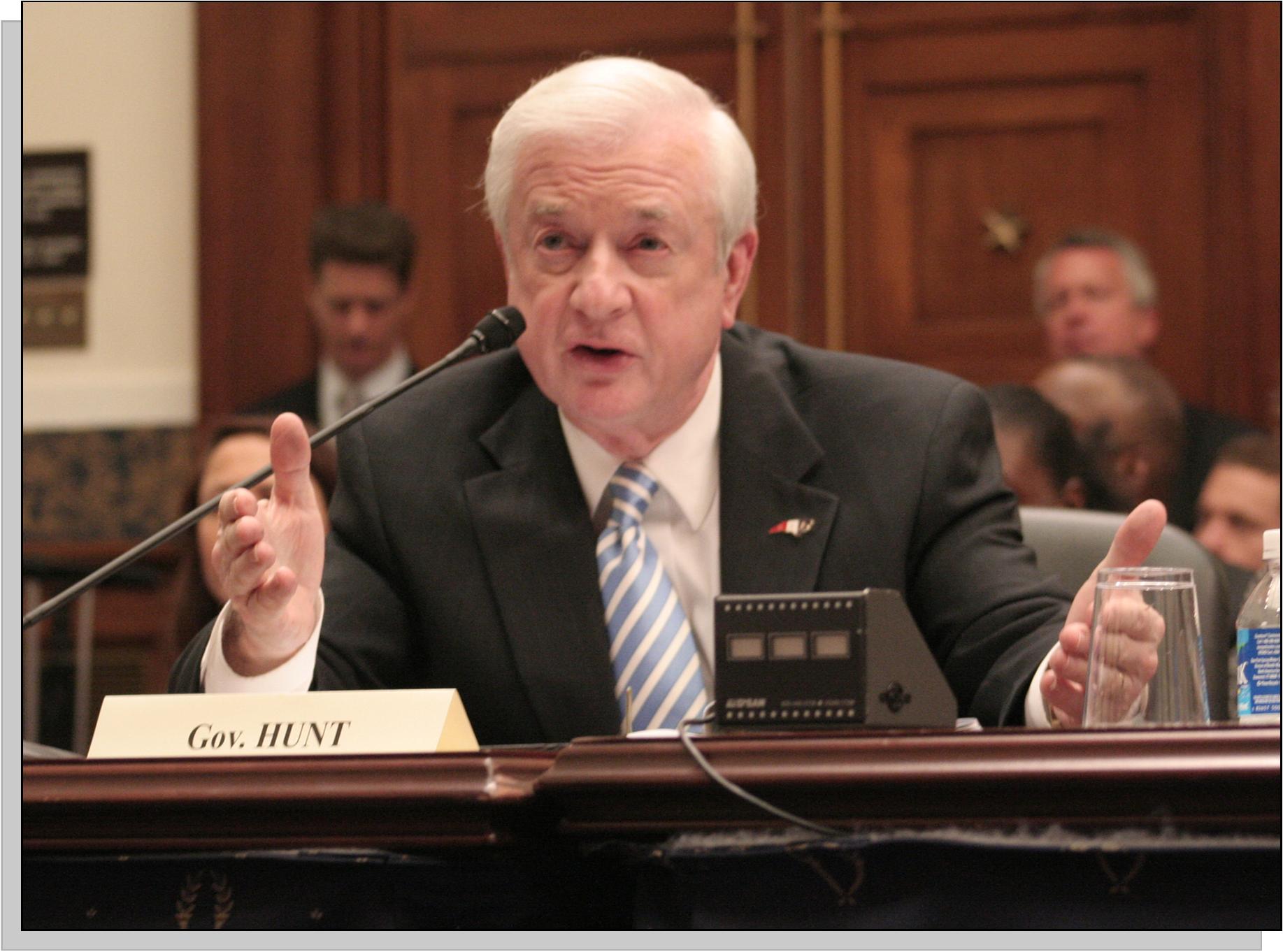
In Raleigh, former two-term Governor Jim Hunt, a Democrat, was returning to the practice of law. He had lost to Helms in the 1984 epic battle of political titans in the US Senate race. Hunt was all washed up; a mere single-entry footnote in the annals of state political history. Wrong.
Jim Hunt, today’s patriarch of the North Carolina Democratic Party, went on to serve a third and fourth term as Governor, a first since 1776. He achieved an extraordinary and unprecedented list of accomplishments … not the least of which was the exalted partisan political triumph of becoming the state Republican Party’s worst nightmare of the past two-and-a-half decades.
As News & Observer political writer Rob Christensen pointed out in his book, The Paradox of Tar Heel Politics, “Hunt kept the Democratic Party from going under during a Republican tide by his political skills, ideological nimbleness, and the fact that he never stopped working.”[ii]
Jim Hunt has become the Michael Jordan, the David Thompson, and the Christian Laettner of modern-day North Carolina politics … that player that is simply better than everyone else on the court. You know the one … the one with the most wins.
This report examines the teachable personal qualities of Jim Hunt, such as “ideological nimbleness” and work ethic, along with the political skills that have made Jim Hunt the extraordinary winner that he has become. What if Hunt had gone to Washington DC in 1985 and Helms had stayed in North Carolina? Is there a Republican Jim Hunt?
Continue reading »