Democrat Roy Cooper’s Gubernatorial Campaign Under Siege by African Americans and Cops Who Feel Betrayed Over Shootings Cooper was Already on Thin Ice with Black Voters If African American turnout in Mecklenburg Country is down substantially this fall due to anger with Democratic leaders over the handling of the police killings in Charlotte,
[More…]
Democrat Roy Cooper’s Gubernatorial Campaign Under Siege by African Americans and Cops Who Feel Betrayed Over Shootings
Cooper was Already on Thin Ice with Black Voters
If African American turnout in Mecklenburg Country is down substantially this fall due to anger with Democratic leaders over the handling of the police killings in Charlotte, all Democrats running in competitive statewide races in North Carolina this fall, especially Democratic gubernatorial nominee Roy Cooper, will be in big trouble. Here’s why:
- There are 227,720 black voters in Mecklenburg County (33% of all county voters)
- Black voters are 74% of all Democrats (308,052) in Mecklenburg County
- More black voters in Mecklenburg County than all Democrats in 38 counties
Many Mecklenburg County black voters were already angry with Roy Cooper over his decision last August not to retry the Charlotte police officer who shot unarmed 24-year old Jonathan Ferrell 10 times on September 14, 2013.
Ferrell, a former Florida A&M football player, had been in a car accident and was attempting to get help when a confused resident called 911 and reported an attempted break-in. Three officers arrived. Ferrell moved towards them in a way that one officer, Randall Kerrick, felt was threatening. Kerrick fired the fatal 10 shots.
Officer Kerrick was not indicted by the first grand jury that heard the case. Attorney General Roy Cooper decided to present the case to a second grand jury. That’s why cops are mad at Cooper. The panel indicted Kerrick on charges of voluntary manslaughter in January, 2014.
The trial began last July. On August 21, 2015, a mistrial was declared by the judge when the jury deadlocked 8-4 after four days of deliberation. The judge’s decision to declare a mistrial was followed by protests in Charlotte that included rocks thrown at officers.
One week later, on August 28, 2015, Attorney General Roy Cooper announced that he would not retry the voluntary manslaughter case against the officer. Cooper said that he was persuaded that a second trial would also end with a deadlocked jury.
Jonathan Ferrell’s family wanted the state to retry the police officer, as did local political leaders like U.S. Rep. Alma Adams and Corine Mack, president of the Charlotte NAACP.
Rev. Dwayne Walker, pastor of Little Rock AME Zion Church, echoed the sentiments of many black Charlotteans when he told the Charlotte Observer, “I just don’t understand how an officer can get away with shooting an unarmed man 10 times.”
Most Democrats in Charlotte agreed.
According to a poll conducted last year immediately after the mistrial, August 26-27, 2015, by Public Policy Polling, a Democratic polling firm based in Raleigh, 6-of-10 Democrats (59%) said the officer in the Jonathan Ferrell case should be retried.
The NAACP, convinced that Roy Cooper had given up on the pursuit of justice, continued to call for a new trial throughout the state.
On September 10, 2015, The Wilmington Journal carried a statement by the NAACP titled, NC NAACP responds to Attorney General Roy Cooper’s refusal to retry officer Randall Kerrick for the wrongful death of Jonathan Ferrell.
Here are highlights (abridged):
- Randall Kerrick, a white officer in Charlotte NC, shot and killed Jonathan Ferrell, an unarmed black male college student. Ferrell was shot ten times.
- While he claims he was under duress, he never used any other form of reasonable force such as pepper spray, his baton or a Taser
- Attorney General Roy Cooper has refused to retry the case stating that, “his prosecutors believe unanimously that a retrial will not yield a different result.”
This year, throughout the state, local news sources have continued to report commentary critical of Attorney General Roy Cooper’s handling of racially sensitive cases. Example: February 24, 2016, Triad City Beat: “Cooper’s track record as attorney general has left many African-American leaders across North Carolina less than enthusiastic about his candidacy.”
Police Walk Out on Cooper over Kerrick Case; Endorse McCrory
For Roy Cooper, the Jonathan Ferrell case has become a lose-lose political dilemma. Not only did African Americans around the state feel betrayed by Cooper for not retrying the case against Randall Kerrick for killing the unarmed Ferrell, but law enforcement officers around the state also felt betrayed by Cooper for seeking an indictment against Kerrick in the first place.
As Jim Morrill noted in his August 16, 2016 story Lingering anger over Kerrick case boils up in N.C. governor’s race, about a third of the officers attending the state convention of the Fraternal Order of Police (FOP) walked out on Attorney General Roy Cooper as he was attempting to justify his decision to prosecute Kerrick for shooting and killing Ferrell.
According to Randy Hagler, state president of the FOP, the Kerrick case was a significant factor in why the organization, with over 6,000 members statewide, voted to endorse North Carolina Governor Pat McCrory this year. (FOP endorsed Democrat Walter Dalton in 2012.)
“We don’t defend bad officers … we try to represent the officers who are on the line making split-second decisions, and that’s the heart and soul of this entire organization,” said one of the delegates to Cooper during the Q&A session.
Then, September 23, 2016. The killing of Keith Scott, another African American male, by a Charlotte police officer. A killing followed by rioting, looting, objects thrown at officers and a protester shot dead. A state of emergency. Police camera footage withheld from the public.
Black voters in Mecklenburg County are furious with Democratic Mayor Jennifer Roberts and the Democratic majority (9-2) Charlotte City Council over the way they managed the crisis. They expressed their fury Monday night at a chaotic city council meeting, calling for the resignation of Roberts and shouting such incendiary phrases as, “Hands down – Shoot back.”
If black voter turnout in Mecklenburg County is down substantially this fall due to anger with local and state Democratic officials, all Democrats running in competitive statewide races this fall, especially Democratic gubernatorial nominee Roy Cooper, will be in big trouble.
– END –
Thanks for reading JDPR TrendLines
 John N. Davis
Need a Political Speaker? If you would like a sensible summary of the status of federal and state elections, go here to check John Davis’ availability.
Subscribe to the John Davis Political Report and JDPR TrendLines here.
The fact is, the Democratic dynasty was already near collapse in 2010 and 2012. The Democratic structural and organizational underpinnings were rotted with corruption, infighting, neglect and diminishing political battlefield competence, making them a very vulnerable political enemy.
Rule #10: No Matter How Often You Read it, the Tortoise Wins and the Hare Loses. Slow and steady is the final key to longevity.
This report is the final in a series highlighting key rules for How the North Carolina Republican Party Can Maintain Political Power for 114 Years (like their predecessors the Democrats). The rules highlighted thus far are:
- Rule #1: Always remember that you are vulnerable
- Rule #2: Criminal indictments scare off contributors
- Rule #3: Keep your voters close, and your metropolitan voters closer
- Rule #4: Caring must be at the core of conservatism
- Rule #5: Lose the courts, lose the war
- Rule #6: Men do not equal a majority
- Rule #7: Welcome young voters with “Come as you are” Open Conservatism
- Rule #8: Obey the Golden Rule of Politics –“Those with the most gold rule”
- Rule #9: If it’s tied, it’s Turnout. If it’s Turnout, it’s Technology
Today, I am adding Rule #10: No Matter How Often You Read it, the Tortoise Wins and the Hare Loses. Slow and steady is the final key to longevity.
May 8, 2013 Vol. VI, No. 10 3:13 pm
This 10-part series on the keys to Republican political longevity began on January 11, 2013, with the caution: don’t create political opportunities for the Democrats by making yourself vulnerable, and the best way to make yourself vulnerable is to think you are not vulnerable.
The greatest source of a sense of invulnerability is pride, the deadliest of the seven deadly sins.
For instance, pride would have Republicans believe that it was their superior might, savvy and ability as political combatants that vanquished the unbeatable foe, the North Carolina Democrats, in 2010 and 2012. If that was the whole story, why did it take the GOP 114 years to defeat them?
The fact is, the Democratic dynasty was already near collapse in 2010 and 2012. The Democratic structural and organizational underpinnings were rotted with corruption, infighting, neglect and diminishing political battlefield competence, making them a very vulnerable political enemy.
Compounding the political instability of North Carolina Democrats was President Obama, who weakened Democrats to the breaking point of defeat all over the United States by racing ahead of the wishes of voters with his own public policy agenda. During his first term, Obama was like the hare in The Tortoise and the Hare, ignoring the value of plodding along patiently with respect for the priorities of most Americans: jobs and the economy.
North Carolina Democrats never seemed to realize that they were creating major breakthrough political opportunities for Republicans by making themselves vulnerable with:
- A 10-year rash of embarrassing criminal indictments that scared off loyal contributors;
- Legislative caucuses that drifted so far left of center that they threatened business leaders;
- Leaders who hogged the glory and ignored the need for a new generation of strong state leaders;
- Standing with President Obama and his personal agenda against the voters and their agenda;
- Buying elections year after year with obligatory loyalty from resentful contributors.
Power corrupts. Absolute power corrupts absolutely. It makes you think you are not vulnerable.
Today, Republicans are the ones with the absolute power in North Carolina. They, like the hare in The Tortoise and the Hare, risk becoming vulnerable by racing so fast to the public policy finish line that they lose sight of the need to bring the voters along with them. Without the support of North Carolina voters, Republican leaders, like Obama, will cause their party a world of hurt.
So, how do you avoid the corrupting influence of absolute power? First, you move at a slow and steady pace that allows for an exchange of information, concerns and ideas with voters locally around the state.
One of the best examples of effective management of sensitive public policy matters by bringing voters along with you is how Senate and House Republican leaders managed reapportionment of legislative and congressional districts. They presented their plans to the public, allowing voters to express their concerns at open forums like local public libraries and community colleges.
Take a look at the list of public hearings and the locations held by the Joint House and Senate Redistricting Committees. Over 100 opportunities for public input were scheduled during the months of April, May, June and July, 2011, for the convenience of North Carolina voters.
The second means of avoiding the corrupting influence of absolute power is to keep yourself humble by surrounding yourself with mementos of past mistakes.
I learned that transformative political lesson in 1979 from a banker in Mississippi.
His name was Bob Hearin. He was the wealthiest man in the state. President and majority stockholder of First National Bank in Jackson.
He was also the most reclusive man in the state.
Despite his great wealth, Bob worked in a drab office cluttered with odd, out-of-place items like rusty machine parts on dusty bookshelves with a small stack of old bricks piled loosely on the floor. A weathered wooden sign leaned against a dingy wall.
It would take weeks for me to finally get up the nerve to ask, “Mr. Hearin, what is all of this junk scattered around your office?”
Unlike most bank presidents, Bob Hearin was so intensely private that no one my age knew what he looked like. We had only seen a picture on the front page of the state’s largest newspaper, The Clarion-Ledger, in the annual article about the “Ten Wealthiest Mississippians.”
Each morning, except Thursdays, Mr. Hearin drove to his downtown Jackson office at First National Bank, the second largest bank in the state, where he would spend the day managing his varied business interests. Each afternoon he left the bank promptly at 3 o’clock and drove out to his farm where he fed his cows from the back of his pickup truck.
In addition to banking, he was a principal stockholder in Amerada Hess, an oil exploration and production company listed on the NYSE and headquartered in New York City, and, at one time, part-owner of the New York Jets.
On Thursdays he flew to New York City in his private jet to meet with his business partner Leon Hess, founder of Amerada Hess and owner of the New York Jets. He always made it back to Jackson in time to feed the cows.
It was because he was so reclusive, that the state’s business and political establishment was shocked when he agreed to serve in the high-profile role as finance chair of Lt. Gov. Evelyn Gandy’s campaign for governor of the Magnolia State. He was returning a favor.
The reason that I know all of this is because I was Evelyn Gandy’s Campaign Manager. I had the unique privilege of meeting with Mr. Hearin daily to discuss campaign finances.
The first day I met with Bob Hearin I was nervous. His personal secretary, Dixie, greeted me with businesslike hospitality at the elevator of the dimly lit and noticeably quiet executive suite. She led me to Mr. Hearin’s office. He immediately came to the door and welcomed me with a warm smile and sincere handshake.
I was surprised by Mr. Hearin’s friendliness; perhaps I expected an old curmudgeon. I was also surprised at his threadbare dark blue suit and his overall disheveled appearance.
The office décor was sparse, more like what you would see in a bus station waiting room rather than in the inner sanctum of the wealthiest man in the state. And then, there were those odd items all around the office. “What were they all about,” I thought curiously.
Over the next several weeks I became increasingly comfortable with Mr. Hearin during our daily meetings. Eventually, we began to talk about things other than the campaign. That was when I learned about his cows and his other business interests and his Thursdays in New York City.
The day finally came when I had the courage to ask him about the odd items in his office. “Mr. Hearin,” I began cautiously, “What is all of this junk scattered around your office?”
His eyes darted from object to object, finally resting on the small stack of bricks. “Those are mementos,” he began pensively, “of every bad loan I have ever made.”
I was stunned.
“See those bricks,” he continued, “I lost over $250,000 on a loan to the company that made those bricks.” He then nodded towards the rusty machine parts, “See those machine parts on the shelf? I lost $100,000 on that bad loan.”
One after another Mr. Hearin pointed out mementos of loans gone bad. Treasured mementos of mistakes. Always in sight. Never to be forgotten. Never to be repeated.
This transformative lesson is particularly valuable in North Carolina politics, the newest of the presidential swing states. The perfectly level political battlefield where there are no permanent partisan advantages. Where nothing can be taken for granted.
In North Carolina politics, you can go from invincible to vulnerable overnight. And no political leader or group is more vulnerable than those who think they are not vulnerable.
Rule #10: No Matter How Often You Read it, the Tortoise Wins and the Hare Loses. Slow and steady is the final key to longevity.
– END –
Thank You for Reading the John Davis Political Report!
John N. Davis, Editor
PS: A new 10-part series highlighting key rules for How North Carolina Democrats Can Recover Political Power will begin the first week in June. Send me your ideas: www.johndavisconsulting.com
SPRING SPECIAL $199: If you are not a subscriber, please consider subscribing. The Premium Annual Subscription only $199 during our Spring Special promotion. Mail your check to John Davis Political Report, P.O. Box 30714, Raleigh, NC, 27622, or subscribe online at www.johndavisconsulting.com/subscribe JND
P.S.: Need a speaker? Inquire about availability here JND
This report is the continuation of a series highlighting key rules for How the North Carolina Republican Party Can Maintain Political Power for 114 Years (like their predecessors the Democrats). The rules highlighted thus far are: Rule #1: Always remember that you are vulnerable Rule #2: Criminal indictments scare off contributors Rule #3: Keep your
[More…]
This report is the continuation of a series highlighting key rules for How the North Carolina Republican Party Can Maintain Political Power for 114 Years (like their predecessors the Democrats). The rules highlighted thus far are:
- Rule #1: Always remember that you are vulnerable
- Rule #2: Criminal indictments scare off contributors
- Rule #3: Keep your voters close, and your metropolitan voters closer
- Rule #4: Caring must be at the core of conservatism
- Rule #5: Lose the courts, lose the war
- Rule #6: Men do not equal a majority
- Rule #7: Welcome young voters with “Come as you are” Open Conservatism
- Rule #8: Obey the Golden Rule of Politics –“Those with the most gold rule”
Today I am adding Rule #9: If it’s tied, it’s Turnout. If it’s Turnout, it’s Technology. North Carolina is tied politically and will be tied for the foreseeable future.
April 24, 2013 Vol. VI, No. 9 8:13 pm
Charlotte, one of the nation’s fastest growing cities of 298 square miles, now has more people than the State of Alaska, which has 586,412 square miles. Alaska has a population of about 730,000 people. Charlotte has a population of 750,000. There are more people in the Charlotte Metropolitan Area than in the states of Wyoming, Vermont, North Dakota and Alaska combined.
The Triangle is also one of the country’s fastest growing metropolitan areas. As to political muscle, Raleigh’s Wake County and Charlotte’s Mecklenburg County cast a combined total of 934,265 votes in the 2012 General Election, the same total as the least populated 61 of North Carolina’s 100 counties.
I say all of this to amplify the most startling fact from the 2012 elections: only about half of the state’s voters are native North Carolinians. According to the March 2013 North Carolina Data-Net, “… barely half of the state’s voters were native North Carolinians. Forty-nine percent [49%] were born elsewhere.”
Why should the growth of new urban voters matter to Republicans? Because the study shows that those who moved to North Carolina in the last 5-to-10 years voted for Obama by 62% over Romney’s 38%.
In just 20 years, our voter rolls have grown from 3.4 million to 6.4 million. That growth rate is projected to continue for decades, steadily shrinking the percentage of native North Carolina voters.
As to the impact of our growth on partisan politics, the Republican share is also steadily shrinking.
In 2006, North Carolina registered Republicans numbered 35% of the 5.5 million voters. By 2010, the Republican share of all registered voters was down to 32% of 6.2 million voters. Today, April 24, 2013, North Carolina Republicans number only 30.8% of 6,624,136 voters.
While the combined total of voters in Wake and Mecklenburg counties have grown by 140% since 1993, Democrats have dropped from 53% of the total to 43%, while Republicans have dropped from 36% to only 28%. Unaffiliated voters have grown from 11% to 29% of the Wake/Mecklenburg total.
Republicans have all of the political power in the state and that means a competitive advantage. However, power has a way of distorting perceptions of reality. Numbers are a reality check.
The reality is that North Carolina is virtually tied politically; a swing state with a level battlefield that favors neither party. Most of the projected growth is in urban counties where the GOP is losing ground.
Don’t bring TV ads to a turnout fight
You’ve heard the old caution, “Don’t bring a knife to a gunfight.” In today’s world of breaking ties in political races, that adage could be written, “Don’t bring TV ads to a turnout fight.”
The 2012 presidential race was tied the entire year. An astounding 97% of likely voters knew whether they were going to vote for or against President Obama the entire fall.
There were very few persuadable voters. You were either going to vote for Obama or not. Period.
Real Clear Politics has compiled a list of 202 national polls conducted from January through November last year that pinned voters down on their voting intentions.
- Not 1 of 35 national polls conducted from Oct 1 to Nov 6, 2012 showed Obama above 50%
- Obama’s average support was 48.8% out of 202 polls; Romney’s average support was 48.1%
- 48.8% plus 48.1% equals 96.9%, leaving only 3.1% of all likely voters undecided
In mid-2011, the Obama camp saw that the race was tied, and that the trend line was flat and likely to hold both candidates just below the winning 50% mark all the way to the finish line. They surmised that a tied race could best be won by getting more of their voters to vote by investing $100 million in data mining and turnout technology.
The brightest Republican consultants surmised that they could break the tie by spending hundreds of millions of TV ad dollars persuading voters that Obama was awful. What they overlooked was the fact that there were very few persuadable voters, and the fact that the Romney vote was unenthusiastic and needed extra prodding to get them to the polls. Romney needed a competitive turnout operation.
Obama’s Strategic Advantage over Romney and GOP Superstars
After reading numerous accounts of how Obama’s Chicago team built a turnout advantage over the Romney team and their $100 million Super PACs led by GOP superstars like Karl Rove, it is clear that it was the investment in technology and an analytics team that broke the tie and won the race.
Read Time’s story, Inside the Secret World of the Data Crunchers Who Helped Obama Win, and you will discover that Jim Messina, Obama’s Campaign Manager, invested $100 million in technology and analytics software. He hired a team of techies five times the size of the 2008 operations group, the group that shattered all voter registration and turnout records.
These data-mining geeks worked in secret in a remote corner of the HQ in Chicago for 18 months, “creating a single massive system that could merge the information collected from pollsters, fundraisers, field workers and consumer databases as well as social-media and mobile contacts with the main Democratic voter files in the swing states.” The Obama megafile allowed the campaign:
- To predict the types of people who would be persuaded by specific messages
- To rank their target lists for unique actions in order of persuadability (register; donate)
- To predict the types of people who would more likely give money online or by mail
- To predict the types of people who would volunteer, and for what type of work
- To raise a record $1 billion war chest
- To register 3 million new voters and turn out voters in swing states in record numbers
Another Time magazine story, Friended: How the Obama Campaign Connected With Young Voters, revealed how the Obama campaign used technology to overcome the challenge of turning out young voters who did not have a land-line phone.
- 85% of Obama’s targeted swing-state voters under age 29 with no listed phone number were found via a Facebook Friends app
- 1 million Obama backers used the app on Facebook, permitting the Chicago HQ analytics geeks to look at their Facebook Friends
- 600,000 Obama supporters used the Facebook app to persuade 5 million of their Facebook Friends to register, contribute and/or vote
- Obama team registered 1.8 million new voters door-to-door; 1.1 million online
Chicago-based data analytics geeks gave President Barack Obama his margin of victory by identifying a powerful new means of “door-to-door contact” by friends: Facebook Friends apps on smartphones and tablets. Friends were contacting friends using texting and social media; the new knock at the door.
North Carolina’s dramatic growth from 3.4 million voters to 6.4 million voters in 20 years has yielded the startling fact that only about half of the state’s voters are natives. That same growth has created a partisan political tie.
Merely making voter registration and turnout a priority is no longer enough. It must be the priority.
Rule #9: If it’s tied, it’s Turnout. If it’s Turnout, it’s Technology. North Carolina is tied politically and will be tied for the foreseeable future.
– END –
Thank You for Reading the John Davis Political Report! John N. Davis, Editor
If you are not a subscriber, please consider subscribing. The Premium Annual Subscription is $245. Mail your check to John Davis Political Report, P.O. Box 30714, Raleigh, NC, 27622, or subscribe online at www.johndavisconsulting.com/subscribe JND
P.S.: Need a speaker? Inquire about availability here JND
If President Obama can legally raise “unlimited amounts of money” for an organization that is a functioning arm of his presidency, North Carolina Republican leaders can do the same. And should.
Remember, it’s a means of keeping your political organization fine-tuned while operating as an IRS approved “social welfare” (wink, wink) organization.
There is a lesson here for North Carolina Republicans; a lesson taught well over the years by Democrats. That lesson is Rule #8: Obey the Golden Rule of Politics – Those with the most gold rule.
“It turns out there is an even higher tier of donors who are granted entree to the board of directors if they raise $1 million for two consecutive years, according to a memo that describes the organization’s “finance leadership levels.”
NY Times, 3/26/2013, regarding Pres. Obama’s new Organizing for Action “Social Welfare” organization
March 27, 2013 Vol. VI, No. 8 11:13 pm
It’s time we put principle aside and do what’s right!
On June 19, 2008, Democratic U.S. Sen. Barack Obama created a firestorm among liberal campaign finance reformers by breaking his pledge to limit his campaign spending to public funds. Obama chose to put the practical value of a campaign spending advantage over personal principle. He knew that in order to win, he had to Obey the Golden Rule of Politics: Those with the most gold rule.
Obama’s decision to put principal aside freed him to raise an unlimited amount of money. Republican nominee John McCain opted to shackle himself to public financing. When the final campaign spending totals were tallied, the FEC reported that Obama had raised $745 million to McCain’s $368 million.
There is a lesson here for North Carolina Republicans.
David Plouffe, campaign manager for President Obama’s 2008 victory, in writing about the decision to opt out of public financing in his book The Audacity to Win, said, “Sacrificing this added cash would mean we either had to pare our list of target battlegrounds or run less rigorous campaigns in each.”
One of those target battlegrounds was North Carolina. If Obama had put principle over money and opted out of public financing in 2008, he would not have carried North Carolina and Beverly Purdue would not have been governor.
North Carolina was Obama’s closest win (14,177 votes out of 4.3 million cast). Perdue’s win was the closest governors race in the U.S., despite her 2-to-1 spending advantage over McCrory ($14.9 million to his $6.7 million) and despite a historic Democratic turnout thanks to Obama’s state organization.
“Staying in the federal system would seriously impede our ability to mount that kind of campaign that left no stone unturned,” wrote Plouffe, “I thought if we opted out of the system, we would also enjoy a significant financial advantage over McCain.” He was right.
In 2008, the Obama campaign raised $782 million (McCain $368 million), employed 6,000 staffers who managed 13 million volunteers. In September alone, Obama raised $100 million online. “There were times when we were raising $250,000, $300,000, even $500,000 an hour,” said Plouffe.
When it comes to principle versus money in politics, ignore the protests of the press and the outrage of the campaign finance reformers; put principle aside and do what’s right: raise money.
This report is the continuation of a series highlighting key rules for How the North Carolina Republican Party Can Maintain Political Power for 114 Years (like their predecessors the Democrats). The rules highlighted thus far are:
- Rule #1: Always remember that you are vulnerable
- Rule #2: Criminal indictments scare off contributors
- Rule #3: Keep your voters close, and your metropolitan voters closer
- Rule #4: Caring must be at the core of conservatism
- Rule #5: Lose the courts, lose the war
- Rule #6: Men do not equal a majority
- Rule #7: Welcome young voters with “Come as you are” Open Conservatism.
Today, I am adding Rule #8: Obey the Golden Rule of Politics –“Those with the most gold rule.”
NC Republicans are only half-way to financial dominance; President Obama points the way to the other half
Thanks to excellent research and analysis of 2012 campaign finances by the North Carolina FreeEnterprise Foundation, we can now say for certain that North Carolina Republicans have learned well from Democrats and are following their precedent in valuing political financial dominance.
- Republican Senate candidates raised about $11.3 million to only $3.7 million for Democratic Senate candidates, a 3-to-1 GOP advantage in 2012 that led to a 33 to 17 Senate majority.
- Republican House candidates raised $12.9 million to $5.3 million for the Democrats, a 2-to-1 GOP advantage in 2012 that led to a 77 to 43 House majority.
- Republican Gov. Pat McCrory raised $11.2 million to $4.3 million for Democratic gubernatorial nominee Walter Dalton, a 2012 advantage that led to a 55% to 43% victory.
Granted, reports like these make it clear that North Carolina Republicans are well on their way to establishing political financial dominance. However, they are only halfway there. The other half of political financial dominance is the establishment of 501 (c) (4) “social welfare” nonprofit groups that may raise and spend unlimited amounts of money to advance their legislative agenda.
Once again, Republicans have an excellent model thanks to President Obama.
Obama’s campaign organization, Organizing for America, has morphed into a new advocacy machine called Organizing for Action. OFA is run by former campaign operatives, like Jim Messina, Obama’s 2012 campaign manager, and pledges to “support the legislative agenda we voted on, train the next generation of grassroots organizers and leaders, and organize around local issues in our communities.”
Sound like something of political value to North Carolina Republicans? Keeping your political organization fine-tuned as an IRS approved “social welfare” organization? Training the next generation of grassroots organizers and leaders? Unlimited shadow funding?
Raise $2 million and you can be on Obama’s board
On Tuesday, March 26, 2013, The New York Times carried a story about Organizing for Action stating, “In addition to the previously reported “board of trustees” whose members are expected to raise at least $500,000, it turns out there is an even higher tier of donors who are granted entree to the board of directors if they raise $1 million for two consecutive years, according to a memo that describes the organization’s “finance leadership levels.”
What are they going to do with all of that money?
According to Organizing for Action’s statement of purpose, they are established to:
- “Support President Obama in achieving enactment of his national agenda.”
- Form grassroots level chapters that will also work for “progressive change on a range of issues at the state and local level.”
- All while operating as a “social welfare” organization” under IRS Code 501(c)(4).
Fred Wertheimer, head of Democracy 21 and a leading national voice for campaign finance reform, described the OFA as “an unprecedented entity that allows individual donors and bundlers to provide unlimited amounts of money to an organization functioning as an arm of the Obama presidency.”
If President Obama can legally raise “unlimited amounts of money” for an organization that is a functioning arm of his presidency, North Carolina Republican leaders can do the same. And should.
Remember, it’s a means of keeping your political organization fine-tuned while operating as an IRS approved “social welfare” (wink, wink) organization.
There is a lesson here for North Carolina Republicans; a lesson taught well over the years by Democrats. That lesson is Rule #8: Obey the Golden Rule of Politics – Those with the most gold rule.
– END –
Thank You for Reading the John Davis Political Report!
John N. Davis, Editor
If you are not a subscriber, please consider subscribing. The Premium Annual Subscription is $245. Mail your check to John Davis Political Report, P.O. Box 30714, Raleigh, NC, 27622, or subscribe online at www.johndavisconsulting.com/subscribe JND
P.S.: Need a speaker? Inquire about availability here JND
North Carolina House Forecasts Show Veto Proof Republican Majority after November 6 Elections “Now, with great deference to the fundamentals for winning campaigns and the standards for political fairness established by the North Carolina Democratic Party, the GOP is setting itself on a sure course for a Republican majority in the House for many elections
[More…]
North Carolina House Forecasts Show Veto Proof Republican Majority after November 6 Elections
“Now, with great deference to the fundamentals for winning campaigns and the standards for political fairness established by the North Carolina Democratic Party, the GOP is setting itself on a sure course for a Republican majority in the House for many elections to come.” John N. Davis, Editor, John Davis Political Report
Wednesday, September 26, 2012 Vol. V, No. 31 11:13 am
Click Here for John Davis Political Report 2012 NC House Forecasts
In 2012, Republicans will win the House majority because they have seized the decided advantage jealously guarded by Democrats since the 19th Century. Click here to see the complete list of NC House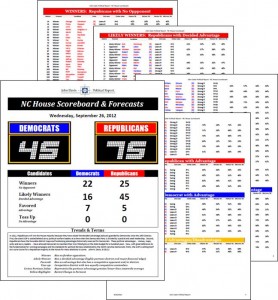 races with forecasts of the likely winners and favored candidates.
Key Conclusions: First, the state GOP is united behind savvy political warfare leaders at a time when the Democratic Party is divided by scandal and weak leadership. Second, Republicans have the favorable district maps and fundraising advantages historically reserved for Democrats.
These political advantages … money, maps, unity and savvy leaders … have allowed Democrats to maintain their iron-fisted grip on the state budget for a hundred years. Now, with great deference to the fundamentals for winning campaigns and the standards for political fairness established by the North Carolina Democratic Party, the GOP is setting itself on a sure course for a Republican majority in the House for many elections to come.
- Winner: Has no further opposition. Democrats 22; Republicans 25.
- Likely Winner: Has a decided advantage (highly partisan district and major financial edge). Democrats 16; Republicans 45.
- Favored: Has an advantage but also has a competitive opponent and/or district. Democrats 7; Republicans 5.
- Toss Up: Competitive district with two equally competitive contenders. Democrats 0; Republicans 0.
– END –
Thank you for reading the John Davis Political Report
John N. Davis, Editor
Premium Annual Subscription is $245. Subscribe online at www.johndavisconsulting.com/subscribe, or mail your check to John Davis Political Report, P.O. Box 30714, Raleigh, NC, 27622. P.S.: Need a speaker? Let me know if you need a speaker or a moderator for a political panel. Audiences are particularly interested in politics this year due to the nation’s economic crisis and the many other uncertainties. Inquire about availability here. JND
North Carolina Senate Forecasts Show Veto Proof Republican Majority after November 6 Elections “Now, with great deference to the fundamentals for winning campaigns and the standards for political fairness established by the North Carolina Democratic Party, the GOP is setting itself on a sure course for a Republican majority in the Senate for many elections
[More…]
North Carolina Senate Forecasts Show Veto Proof Republican Majority after November 6 Elections
“Now, with great deference to the fundamentals for winning campaigns and the standards for political fairness established by the North Carolina Democratic Party, the GOP is setting itself on a sure course for a Republican majority in the Senate for many elections to come.” John N. Davis, Editor, John Davis Political Report
Tuesday, September 25, 2012 Vol. V, No. 30 11:13 am
Click Here for John Davis Political Report 2012 NC Senate Forecasts
In 2012, Republicans will win the Senate majority because they have seized the decided advantage jealously guarded by Democrats since the 19th Century. Click here to see the complete list of NC Senate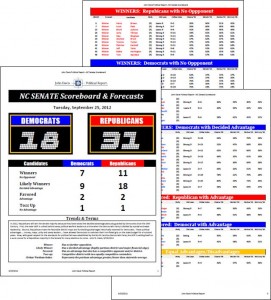 races with forecasts of the likely winners and favored candidates.
Key Conclusions: First, the state GOP is united behind savvy political warfare leaders at a time when the Democratic Party is divided by scandal and weak leadership. Second, Republicans have the favorable district maps and fundraising advantages historically reserved for Democrats.
These political advantages … money, maps, unity and savvy leaders … have allowed Democrats to maintain their iron-fisted grip on the state budget for a hundred years. Now, with great deference to the fundamentals for winning campaigns and the standards for political fairness established by the North Carolina Democratic Party, the GOP is setting itself on a sure course for a Republican majority in the Senate for many elections to come.
- Winner: Has no further opposition. Democrats 7; Republicans 11.
- Likely Winner: Has a decided advantage (highly partisan district and major financial edge). Democrats 9; Republicans 18.
- Favored: Has an advantage but also has a competitive opponent and/or district. Democrats 2; Republicans 2.
- Toss Up: Competitive district with two equally competitive contenders. Democrats 1; Republicans 1.
Tomorrow, Wednesday, September 26, the John Davis Political Report will publish a forecast of all 120 NC House races.
– END –
Thank you for reading the John Davis Political Report
John N. Davis, Editor
Premium Annual Subscription is $245. Subscribe online at www.johndavisconsulting.com/subscribe, or mail your check to John Davis Political Report, P.O. Box 30714, Raleigh, NC, 27622. P.S.: Need a speaker? Let me know if you need a speaker or a moderator for a political panel. Audiences are particularly interested in politics this year due to the nation’s economic crisis and the many other uncertainties. Inquire about availability here. JND
Is the NC Democratic Party Better Off than Four Years Ago? That’s why Obama can’t carry the state in 2012. The North Carolina Democratic Party, the storied, national-model political war machine of 2008, is too deficient structurally to win 2012 battles. Tuesday, September 4, 2012 Vol. V, No. 27 5:13 pm First Generation of Leaders
[More…]
Is the NC Democratic Party Better Off than Four Years Ago? That’s why Obama can’t carry the state in 2012.
The North Carolina Democratic Party, the storied, national-model political war machine of 2008, is too deficient structurally to win 2012 battles.
Tuesday, September 4, 2012 Vol. V, No. 27 5:13 pm
First Generation of Leaders to Lose Legislature to Republicans Since 1898
The North Carolina Democratic Party, a storied national model political war machine with a 112-year winning streak in political dominance; a party that distinguishes itself, along with Oregon and Washington, as one of only three states with no Republican governor in 20 years, finds its political war machine unable to fend off an insurgent state GOP in 2012.
Collapsed. No power. No money. No momentum. No maps. Lost it all in 2010. Lost the state Senate. Lost the state House of Representatives. First time since 1898.
No political warfare generals. The collapse of the strong leadership infrastructure and financial advantage of the state Democratic Party since 2008, and the concurrent building of a strong leadership infrastructure and financial advantage by the state Republican Party, argue for a difficult year for Democrats in North Carolina in 2012. Including President Obama.
Governor Beverly Perdue, a lame duck whose disapproval rating per Public Policy Polling was “the worst any Governor in the country has in our most recent polling,” chose wisely not to seek a second term. Dramatic shift in political fortunes since 2008. Governor Perdue had eleven (11) vetoes overridden by the first GOP General Assembly since 1898. A lame duck.
In 2008, Democratic Governor Beverly Perdue barely won the closest governor’s race in America despite outspending her GOP opponent, former Charlotte Mayor Pat McCrory, by 2-to1: $14.9 million to $6.7 million.
And, she barely won during a terrible turnout year for Republicans and an Obama-driven historic turnout year for Democrats. McCrory would have won in 2008 but for Barack Obama’s investment in North Carolina and a structurally deficient North Carolina GOP.
In July, 2012, Pat McCrory, the GOP nominee for governor, reported $4.4 million cash on hand. Walter Dalton, the Democratic nominee for governor, reported $714,000 cash on hand. McCrory has already reserved over $6 million in TV time for the fall. Dalton: $2.6 million.
The Republican Governor’s Association has committed an additional $5.2 million.
September 4, 2012 Real Clear Politics Polling Average: McCrory 46.6%; Dalton 39%.
The North Carolina Democratic Party is not better off than it was four years ago when Barack Obama won by 14,000 votes out of 4.3 million cast.
That’s why President Obama cannot carry the state in 2012.
Structural Deficiencies Since 2008 Seen in Mid-Year Fundraising Reports
There is no greater indicator of structural deficiencies than fundraising results. According to The Associated Press, “The North Carolina Democratic Party, which has staggered through months of infighting in the wake of sexual harassment allegations at party headquarters, is well behind in the race for money with Republicans heading into the fall election.”
The AP story on the mid-year reports filed with the State Board of Election included:
NC Democratic Party has raised “a little less than $185,000” during the second quarter of 2012, and had “$188,000 in cash on hand.”
- NC Republican Party has raised “nearly $772,000” during the second quarter of 2012, and had “$965,500 in cash.”
- When it comes to individual contributors, “The reports show Republicans raked in $212,000, while Democrats brought in a meager $2,700, the reports said.”
Sen. Basnight reported $1,086,815 cash in 2008; Sen. Nesbitt reported $45,000 cash in 2012
Four years ago, when the July report was filed with the State Board of Elections, then-Senate President Pro Tem Marc Basnight, D-Dare, reported $1,086,815 cash on hand. This July, NC Senate Minority Leader Martin Nesbitt, D-Buncombe, reported $45,000 cash on hand.
Money flows to those with power. Democrats no longer have power. No power, no money. No money, no resources to do political battle. That’s a game changing structural deficiency.
Conversely, NC Senate President Pro Tem Phil Berger, R-Rockingham, reported $770,000 cash on hand in the July campaign finance reports. Four years ago, then-Senate Minority Leader Phil Berger reported only $92,404 cash on hand.
NC House Speaker Thom Tillis, R-Mecklenburg, reported raising $945,942 this election cycle, with $491,877 cash on hand after a $200,000 contribution to the state party. Four years ago, then-GOP House Minority Leader Paul Stam, R-Wake, reported a meager $43,312 cash on hand.
North Carolina No Longer a Presidential Swing State; Obama Likely to Pull Out
Forecast: North Carolina will soon be taken off most “Swing States” lists and relabeled “Leaning Romney.” Obama will redirect NC resources to greener pastures.
The big mistake the Obama camp made this year in investing in North Carolina was in thinking that Obama carried the state in 2008 because he was a Democrat or because he was progressive or because he was charismatic. Fact: Obama was the only other option on the ballot at a time when voters had lost trust in the Republican leaders and their ideas.
Obama won by 14,179 votes out of 4,310,623 cast in 2008.
- Obama won because President Bush had a job approval of 25%.
- Obama won because McCain was feared as a third Bush term.
- Obama won because the GOP took the state for granted.
- Obama won because he had the surprise factor (no one saw it coming).
- Obama won because he beat the GOP with registration and early voting turnout.
Public opinion research released this week shows Mitt Romney leading President Obama in North Carolina 47% to 43% in a new Elon University/News & Observer poll, and 46% to 43% in a new High Point University/Fox 8 poll.
September 4, 2012 Real Clear Politics Polling Average: Romney 47.3%; Obama 45.3%.
Greatest Structural Deficiency: Waning Democratic Enthusiasm; 38 Point Shift
According to a Gallup poll released July 25, only 39% of Democrats are “more enthusiastic about voting than usual,” compared to 51% of Republicans. That’s a 12-point advantage for the Republicans. There’s more.
At the same time in the summer of 2008, 61% of Democrats were “more enthusiastic about voting than usual,” compared to only 35% for Republicans. That’s a 26-point advantage for the Democrats.
For emphasis: Democrats have not only lost their 26-point advantage, Republicans have gained a 12-point advantage, for a net gain of 38 points for Republicans since the summer of 2008.
Least enthusiastic: young unemployed/underemployed voters. Obama volunteers.
The North Carolina Democratic Party was already in freefall without the help of President Obama. With the help of Obama in 2010, Democrats suffered the greatest losses since 1896.
Is the North Carolina Democratic Party better off than it was four years ago?
That’s why President Obama cannot carry the state in 2012.
– END –
Thank you for reading the John Davis Political Report
John N. Davis, Editor
Premium Annual Subscription is $245. Subscribe online at www.johndavisconsulting.com/subscribe, or mail your check to John Davis Political Report, P.O. Box 30714, Raleigh, NC, 27622. P.S.: Need a speaker? Let me know if you need a speaker or a moderator for a political panel. Audiences are particularly interested in politics this year due to the nation’s economic crisis and the many other uncertainties. Inquire about availability here. JND
Post: October 10, 2011 Vol. IV, No. 27 “To compromise one’s principles of right/wrong for the sake of getting something done will only lead us to where we are today: a country and a society of mediocrity.” Undisclosed NC Republican legislator, September 28, 2011 1964 GOP Presidential nominee Barry Goldwater Lost 61.1% to 38.5% After
[More…]
Post: October 10, 2011 Vol. IV, No. 27
“To compromise one’s principles of right/wrong for the sake of getting something done will only lead us to where we are today: a country and a society of mediocrity.”
Undisclosed NC Republican legislator, September 28, 2011
1964 GOP Presidential nominee Barry Goldwater Lost 61.1% to 38.5%
After my report two weeks ago titled, “Compromise” or “Stick to Beliefs” Study Explains NJ Gov. Chris Christie Can Defeat President Barack Obama, I received the following emailed comment from a Republican member of the legislature … a friend with sensible views I have long admired:
“To compromise one’s principles of right/wrong for the sake of getting something done will only lead us to where we are today: a country and a society of mediocrity. We must continue our struggle in the pursuit of excellence and return to the fundamental principles upon which American greatness was built upon. Compromise is not the answer.”
I immediately thought about the 1964 GOP nominee for President Sen. Barry Goldwater, R-Arizona, and his famous battle cry, “Extremism in the defense of liberty is no vice!”
Extremism in the defense of liberty cost the GOP the White House in 1964, and extremism in the defense of uncompromising economic conservatism during the worst recession since the Great Depression will cost the GOP the White House in 2012. It is simply politically inept.
However, it cuts both ways.
Uncompromising liberal economic extremists (Democrats and Republicans) got this country into the crisis we all face today. For decades, in Washington D.C. and in Raleigh, N.C., liberals have refused to be restrained by the economic caution of conservatives when it comes to government spending.
The unwillingness of liberals to compromise is the reason our country got into this crisis, and the unwillingness of conservatives to compromise is the reason we can’t get out of this crisis.
24,845,594 Reasons Conservative Economic Extremism will Cost the GOP
Take a look at today’s US Debt Clock, a real-time accounting of our nation’s finances, and you will see that “Actual Unemployed” in the United States is 24,845,594. The Bureau of Labor Statistics defines “Actual Unemployed” as the total unemployed, added to all marginally attached workers, plus those working part time but want to work full time.
In my report “Compromise” or “Stick to Beliefs” Study Explains Why NJ Gov. Chris Christie Can Defeat President Barack Obama, I wrote about a Gallup survey released Monday, Sept. 26, that shows that Americans strongly prefer leaders who will compromise to stimulate the economy and jobs growth.
- It’s more important to “compromise” in order to get things done say 51% of Americans, as compared to only 28% who say “Stick to beliefs” even if little gets done. The remaining 21% are neutral.
- Republicans are evenly split: 37% “Stick to beliefs;” 36% “Compromise.” Neutral: 27%.
- Democrats are overwhelmingly for “Compromise” (62%) in order to get things done in Washington compared to only 20% who say “Stick to beliefs” even if little gets done. Neutral: 18%.
- By almost 2-to-1, Independents say it’s “more important to compromise” in order to get things done (52%) than it is to “stick to beliefs” even if little gets done (27%).
Voters want jobs and job security, not ideological defiance. Voters want a bipartisan long-range plan for dealing with the nation’s debt and deficit crisis, not economic Puritanism.
Don’t Tell Mama I’m a Member of the U.S. Congress, She Thinks I’m a Lobbyist
There is an old joke passed down for many generations in political circles that goes like this: “Don’t tell mama I’m a lobbyist, she thinks I’m a piano player at a house of ill repute.” Well, in today’s hostile political environment that joke could easily be rewritten: “Don’t tell mama I’m a member of the U.S. Congress, she thinks I’m a lobbyist.”
A new national survey by Gallup released Today, Wednesday, October 12, 2011 reveals that the U.S. Congress is “on track to register its lowest annual average approval rating for any year since Gallup began measuring congressional approval in 1974.”
- Only 13% of Americans approve of the way Congress is handling its job.
- Republicans’ and Democrats’ approval of Congress is identical, at 14%, similar to the 13% among independents.
- Comparison: President Obama’s job approval is 41% today, October 12, 2011
NOTE for Clarification: When pollsters measure the job approval of the U.S. Congress, they are referring to the U.S. Senate and the U.S. House of Representatives.
Many in the GOP seem to miss the fact that the 47 Republican members of the U.S. Senate and the 240 Republican members of the U.S. House are included in the historic high dissatisfaction with Congress. Republicans have 287 of the 535 members of Congress, or 54%.
If 81% of Americans disapprove of the job Congress is doing, that includes most Republicans in America disapproving of the job the Republicans in Congress are doing.
Economic Extremism will cost the GOP dearly in 2012 … but there is a win-win
Republicans are in trouble with American voters because they have allowed the most conservative among them to put “sticking to beliefs even if little gets done” ahead of “compromising in order to get things done.”
Voters want jobs and economic stability, not ideological defiance. Voters want a bipartisan long-range plan for dealing with the nation’s debt and deficit crisis, not economic Puritanism.
So, to my Republican friend with a history of sensible views while serving in the legislature who wrote me that “Compromise is not the answer,” please remember that in 1964, Barry Goldwater received only 38.5% of the votes to 61.1% for President Lyndon Johnson. Goldwater carried 6 states out of 50 (AZ, LA, MS, AL, GA, SC), and only 52 electoral votes compared to 486 for Johnson.
Still not willing to compromise? OK, there is a way out without having to compromise … collaborate. At least be willing to collaborate. It’s your best hope of ending the worst recession since the Great Depression, jump-starting jobs growth, and restoring confidence with a long-range plan for stability.
– END –
Thank you for reading the John Davis Political Report!
John N. Davis, Editor
Premium Monthly Subscription $245. Premium Election Cycle Subscription $315 (through 12/31/2012!) Monthly rate for Premium Annual Subscription is now available at $23 per month (cancel at any time). Click HERE to PRINT Subscription Reply Form. Subscribe online HERE!
“Compromise” or “Stick to Beliefs” Study Explains NJ Gov. Chris Christie’s Appeal to the GOP and Why He Can Defeat President Barack Obama Post: September 28, 2011 Vol. IV, No. 26 “And that’s the key. You can’t ask people to violate their principles. And so there has to be a way to find principled outcome
[More…]
“Compromise” or “Stick to Beliefs” Study Explains NJ Gov. Chris Christie’s Appeal to the GOP and Why He Can Defeat President Barack Obama
Post: September 28, 2011 Vol. IV, No. 26
“And that’s the key. You can’t ask people to violate their principles. And so there has to be a way to find principled outcome where people are also compromising.”
Gov. Chris Christie, R-New Jersey, Meet the Press, June 26, 2011
Less than Half of Tea Party Supporters Say “Stick to Beliefs”
Fiscal conservatives who believe that it’s more important for our leaders in Washington to “Stick to their beliefs even if little gets done” than it is to “Compromise in order to get things done” will be happy to know that almost half of all Tea Party supporters agree, according to an new Gallup survey released yesterday.
Ummmmmm, only half?
A Gallup survey released Monday, Sept. 26, shows that 45% of Tea Party supporters say it’s more important for leaders in Washington to “Stick to their beliefs” even if little gets done. A surprising 31% of Tea Party supporters say it’s more important to “Compromise” in order to get things done.
Here is the Gallup question:
“Is it more important for political leaders in Washington to compromise in order to get things done or is it more important to stick to their beliefs even if little gets done.”
- It’s more important to “compromise” in order to get things done say 51% of Americans, as compared to only 28% who say “Stick to beliefs” even if little gets done. The remaining 21% are neutral.
- Republicans are evenly split: 37% “Stick to beliefs;” 36% “Compromise.” Neutral: 27%.
- Democrats are overwhelmingly for “Compromise” (62%) in order to get things done in Washington compared to only 20% who say “Stick to beliefs” even if little gets done. Neutral: 18%.
Independents are 2-to-1 “Compromise” over “Stick to Beliefs;” Problematic for Current Slate of GOP Presidential Contenders
The most ominous message for uncompromising fiscal conservatives in the new Gallup survey is that by almost 2-to-1, Independents say it’s “more important to compromise” in order to get things done (52%) than it is to “stick to beliefs” even if little gets done (27%).
The Tea Party has an inordinate amount of influence over the GOP’s 2012 presidential nomination process. There is no greater evidence of that point than the fact that the entire GOP presidential slate agreed that they would say “no” to a deficit/debt reduction deal of $10 in spending cuts to $1 in increased revenue.
On August 11, 2011, GOP presidential contenders staked themselves out as uncompromising fiscal conservatives when asked a question by Bret Baier, the moderator at the Iowa Presidential Debate, on the matter of whether to accept a 10-to-1 deal of spending cuts over tax increases.
BRET BAIER: Well, I’m going to ask a question to everyone here on the stage. Say you had a deal, a real spending cuts deal, 10-to-1, spending cuts to tax increases. Who on this stage would walk away from that deal? Can you raise your hand if you feel so strongly about not raising taxes, you’d walk away on the 10-to-1 deal?
BAIER: OK. Just making sure everyone at home and everyone here knows that they all raised their hands. They’re all saying that they feel so strongly about not raising taxes that a 10 to 1 deal, they would walk away from.”
When I saw all eight Republican candidates for president at the Iowa debate on August 11 say that they would not accept a 10-to-1 deal of spending cuts to tax increases I immediately thought, “Obama just won a second term.”
NJ Gov. Chris Christie’s Unique Strength is in Dealing with Adversaries: “Principled Outcome Where People are Also Compromising.”
New Jersey Gov. Chris Christie was a guest on Meet the Press on June 26, 2011 (Transcript here).
The debt ceiling debate was stalled. The president was finally stepping into the negotiations. The American public was divided according to an AP poll: 41% opposed to raising the debt ceiling; 38% favored raising the debt ceiling.
David Gregory, host of Meet the Press, opened the show with a taped interview with Gov. Christie after noting that Christie was coming off a big budget victory where the Democratic-controlled New Jersey State Assembly passed a landmark cost-cutting budget that would save the state $120 billion over the next 30 years.
MR. GREGORY: “The battle, of course, [here in Washington] is between spending and taxes. What’s the way out of this mess here?
GOV. CHRISTIE: “The first thing is that the president had to get involved personally. And what I found in New Jersey, in our experience in dealing with what you just talked about, was there is no substitute for the three leaders in the room having to look at each other and having to hash this out. And everybody’s got to put skin in the game, David. I mean, I gave on things that I wanted. Obviously, the Senate–Democratic Senate president in my state, and the Democratic speaker gave on things they wanted, and we came to a compromise that didn’t violate our principles. And that’s the key. You can’t ask people to violate their principles. And so there has to be a way to find principled outcome where people are also compromising.”
“We came to a compromise that didn’t violate our principles.” That’s the appeal of New Jersey Gov. Chris Christie to the GOP and the best argument for why he can defeat President Obama in 2012.
Throughout all of my reporting on the presidential race I have maintained that President Obama would defeat the current slate of contenders … in great part because they would not compromise on a 10-to-1 deal of spending cuts over new taxes.
I have also said repeatedly that if NJ Gov. Chris Christie is the nominee, all bets are off.
The new Gallup study showing that Americas prefer that our leaders in Washington “Compromise” in order to get things done rather than “Stick to Beliefs” even if little gets done explains NJ Gov. Chris Christie’s appeal to the GOP … and why he can defeat President Barack Obama.
“We came to a compromise that didn’t violate our principles.” That’s the leadership Americans are looking for … and deserve.
– END –
Thank you for reading the John Davis Political Report!
John N. Davis, Editor
Premium Monthly Subscription $245. Premium Election Cycle Subscription $315 (through 12/31/2012!) Monthly rate for Premium Annual Subscription is now available at $23 per month (cancel at any time). Click HERE to PRINT Subscription Reply Form. Subscribe online HERE!
No Shortcuts to Peace, Prosperity … or Dreams; Updated Forecasts of Likely Winners: President, GOP Nominee, U.S. Congress Post: September 22, 2011 Vol. IV, No. 25 “What they’re in essence doing is they are voting to spend more money, because that’s exactly what will happen.” U.S. House Speaker John Boehner, R-Ohio, September 22, 2011, chiding the
[More…]
No Shortcuts to Peace, Prosperity … or Dreams; Updated Forecasts of Likely Winners: President, GOP Nominee, U.S. Congress
Post: September 22, 2011 Vol. IV, No. 25
“What they’re in essence doing is they are voting to spend more money, because that’s exactly what will happen.”
U.S. House Speaker John Boehner, R-Ohio, September 22, 2011, chiding the 48 GOP caucus members for voting against the stopgap measure yesterday.
No Shortcuts to Peace, Prosperity … or Dreams
The headline above the fold in today’s News and Observer is, “Obama: no shortcut to peace.” The quote was from President Obama’s speech yesterday to the United Nations in which he urged Israel and Palestine to settle their differences without relying on UN action.
On the economic front, he could have added, “and there is no shortcut to prosperity.”
A few years ago, I drove my daughter and her friend to New York City for a week of theater and shopping. She had dreamed of such a week for a long time and had saved over $1000.
It worked out quite well for me. After all, for some time I had wanted to get away to work on a book I had dreamed of writing. This was the perfect opportunity. The girls would leave the room mid-morning and spend the entire day in the city and not come back to the hotel room except to dress for an evening performance. I would be free to write all day the entire week.
What I did not anticipate was a near-fatal case of writers block.
Despite numerous attempts to establish momentum, I ended the first day with very little accomplished. That was followed by a second day of struggling to be productive … although I ended the day with a glimmer of hope after a couple of hours of research at New York City’s Mid-Manhattan Public Library.
Surely the third day would be a breakthrough of productivity. Not so. As noontime rolled around, I was no farther along than when I started the day. Frustrated, I decided to take a walk.
After a couple of blocks of aimless wandering, I noticed a crowd of people walking into St. Patrick’s Cathedral on 5th Avenue for the noon mass. Not having any better idea of what to do with my time, I decided to join them. Maybe prayer and meditation would jump-start my writing.
Voila! I found the remedy to my chronic writers block that day … in the homily. The title of the homily was, “There are no shortcuts to your dreams.”
I went straight back to the room and went to work. I ended up having a very productive week.
U.S. House Speaker Boehner Chastises Tea Party Republicans
We should all thank the Tea Party for forcing a nation in economic denial to see the nation-destroying consequences of unlimited sacred cow budgeting and unchecked spending and borrowing.
However, if the Tea Party does not loosen up on opportunities like a 10-to-1 spending cuts over tax increases, insisting on no new taxes, then it will be the Democrats who will be thanking the Tea Party for returning them to state and federal legislative majorities.
U.S. House Speaker John Boehner, R-Ohio, said as much today when he chastised the 48 members of the GOP caucus for voting against the stopgap measure yesterday. “What they’re in essence doing is they are voting to spend more money, because that’s exactly what will happen.”
There are no shortcuts to:
- Adjusting to the global economic correction: a monumental event likely requiring a painfully interminable period of austerity;
- Economic growth or job creation: an exercise requiring cautious and deliberate investments by the private sector in expansion that eventually will begin to add jobs;
- Getting our budget under control: an exercise requiring both painful spending cuts and program consolidation/elimination and tax reform … including new revenue.
Saying no to taxes is a shortcut.
Updated Likely Winners: President, GOP Nominee, U.S. Congress
On Labor Day, September 2, 2011, I published forecasts for the likely winners of the 2012 campaigns for U.S. President, GOP Presidential Nominee, U.S. Senate, U.S. House, N.C. Governor and the likely North Carolina Senate and House majorities. Here are select updates:
U.S. President UPDATE 9/22: Obama will win a second term (without NC)
- Obama’s mid-40s job approval (43.6% Real Clear Politics average) at the lowest point of his administration, amidst worldwide economic turmoil and high dissatisfaction and uncertainty at home, argues for a near-50% job approval next fall with any measure of sustained growth in jobs/economy. He wins at 50%.
- Obama will run against “obstructionist” Republicans in Congress whose job approval hovers around 15% (Congressional job approval 13.5% Real Clear Politics average)
- Everyone in the current GOP presidential field has said “no” to a 10-to-1 spending over taxes deal and are losing credibility among most voters because their uncompromising stand.
- GALLUP released a survey September 20 in which:
- 70% of Americans favor “increasing taxes on some corporations by eliminating certain tax deductions,” including 53% of Republicans/Leaning Republican.
- 66% favor “increasing income taxes on individuals earning at least $200,000 (families $250,000),” including 41% of Republicans/Leaning Republicans.
- Over half of Republicans/Leaning Republicans favor 4 of the 6 proposals in Obama’s American Jobs Act including 84% who support “providing tax cuts for small businesses, including incentives to hire workers,” 56% who support “providing additional funds to hire teachers, police officers, and firefighters,” and 50% who support “providing additional funds for public works projects, including making repairs to more than 30,000 schools.”
Republican Senate Minority Leader Mitch McConnell, R-KY, reaffirmed in a Fox News Sunday interview on July 10, 2011, that “the single most important thing we want to achieve is for President Obama to be a one-term President.”
The greatest political trap that Republicans could find themselves in is for voters to conclude that their refusal to compromise on the American Jobs Act is driven by their #1 priority, to make Obama a one-term president.
GOP Presidential UPDATE 9/22: Mitt Romney likely GOP nominee
- Rick Perry will collapse under the weight of inexperience and cowboy bravado too reminiscent of President Bush.
- If Perry wins the nomination, most Americans will likely see him as a 3rd Bush term (Bush’s job approval was 25% in 2008), weakening his chances in a General Election.
- Romney will win out of the current field because he will be the last one standing after the others self-destruct. Romney cannot beat Obama without enthusiastic Republican and Tea Party support … and he has yet to generate much enthusiasm among right-wing conservatives.
- Recent polls show 51% of Republicans would prefer someone other than the current slate.
- NJ Governor Christ Christie can defeat Obama. Filing/running required.
U.S. Senate UPDATE 9/22: Republicans will win the U.S. Senate majority
- Currently 51/47 Democrat majority w/2 Independents who caucus with Democrats.
- Big GOP Advantage: Of 33 US Senate seats up for grabs, 21 are currently held by Democrats and 2 held by Independents who caucus with Democrats.
- Only 10 Republican seats are up for grabs in 2012, most deemed safe.
- GOP needs to win 4 of the 21 Democratic seats for majority (if they hold what they have).
U.S. House UPDATE 9/22: Republicans risk losing U.S. House majority
Republicans are clearly at risk of losing the majority in the US House of Representatives, as uncompromising Tea Party zealots will alienate independents as well as defeat/weaken GOP incumbents, rendering them vulnerable to moderate Democrats in swing districts.
U.S. House Speaker John Boehner, R-Ohio, chided the 48 Republicans in his caucus this morning for rejecting the stopgap government funding bill on Wednesday, causing the bill to fail. “What they’re in essence doing is they are voting to spend more money, because that’s exactly what will happen,” Boehner told reporters today.
The uncompromising actions of the Tea Party Republicans in the U.S. House have led to fears of a government shutdown reminiscent of the one under former Speaker Newt Gingrich, an event that led to the loss of confidence in Republicans … and the loss of the majority in Congress to the Democrats.
U.S. House Republicans cannot lose more confidence in their ability to lead. There’s none left.
– END –
Thank you for reading the John Davis Political Report!
John N. Davis, Editor
NEW Premium Monthly Subscription! Due to popular demand, a monthly rate for the $245 half-price Premium Annual Subscription to the John Davis Political Report is now available at $23 per month (cancel at any time).
Click HERE to PRINT Subscription Reply Form. Subscribe online HERE!